How to Build a Strong Brand From Scratch: 7 Steps for 2026


Listen up, aspiring internet hustler! If you’re reading this, you’re probably sick of being just another faceless entity in the vast ocean of online mediocrity.
Well, that’s going to change after reading this article. So buckle up, because I’m about to drop some knowledge bombs on how to build a brand so strong in 2026 that even your cat will be sliding into your DMs for collab opportunities.
And this isn’t theory from the sidelines. We’re building NetHustler one piece at a time, and at the moment that means growing the blog and adding free tools for online sellers and freelancers, so there’s something useful for you every time you stop by.
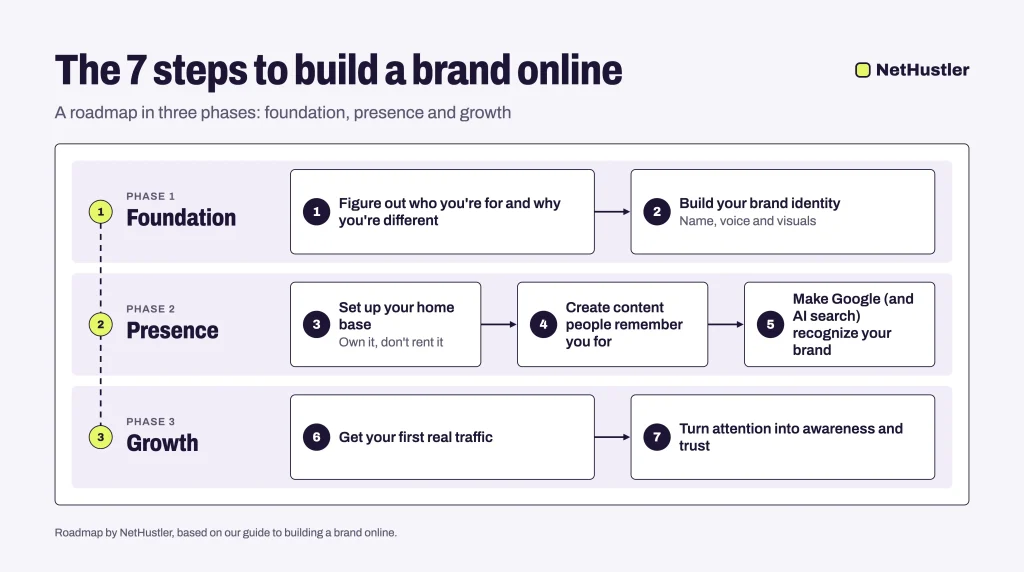
Alright, here’s a short snippet of what the steps are to build a strong online brand:
- Figure out who you’re for and why you’re different
- Build your brand identity (name, voice and visuals)
- Set up your home base (own it, don’t rent it)
- Create content people remember you for
- Make Google (and AI search) recognize your brand
- Get your first real traffic
- Turn attention into awareness and trust
Step 1: Figure out who you’re for and why you’re different
You can’t just start advertising and publishing your face all over the internet without a strategy and without knowing who you are and what you want to do. Shocking, I know. But seriously, if you can’t explain your brand in a sentence, you’re kinda lost. So, since you don’t want to be lost and create generic boring stuff, check this out:
- Find Your Niche: What makes you special and unique? Figure it out and own it. Seriously, you have to be good and like what you do.
- Define Your Values: What do you stand for? Besides making money, obviously. You don’t want to rip people off just to make a quick buck, so make sure you provide value above everything. Write down one rule you’ll always follow and one line you’ll never cross.
- Know Your Audience: Who are you talking to? If your answer is “everyone,” congrats, you’ve failed step one. Read Reddit threads in your niche, comments on competitors’ top YouTube videos, and 3-star reviews on Amazon or G2. Copy their exact phrases for your headlines later.
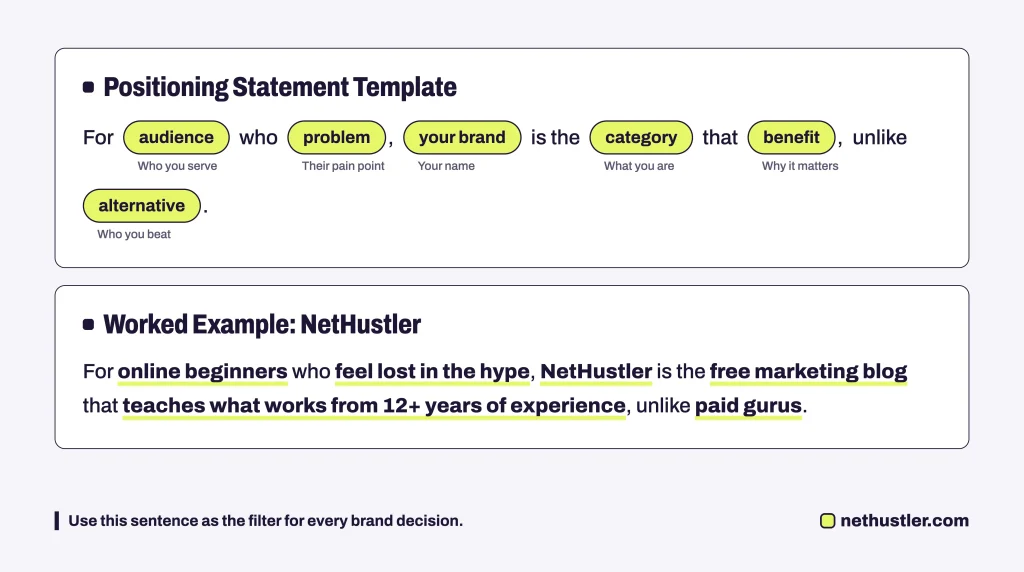
- Write Your Positioning Statement. This sentence becomes your filter for every decision:
For audience who problem, your brand is the category that benefit, unlike alternative.
Step 2: Build your brand identity (name, voice and visuals)
Your visual identity is like your online face – it better be good, or you’re in for a world of hurt.
- Check your name first. Make sure the domain is available and nobody in your niche already uses it. In the US, run it through the USPTO’s free trademark search too (not legal advice). For a personal brand, your own name is usually the safest bet.
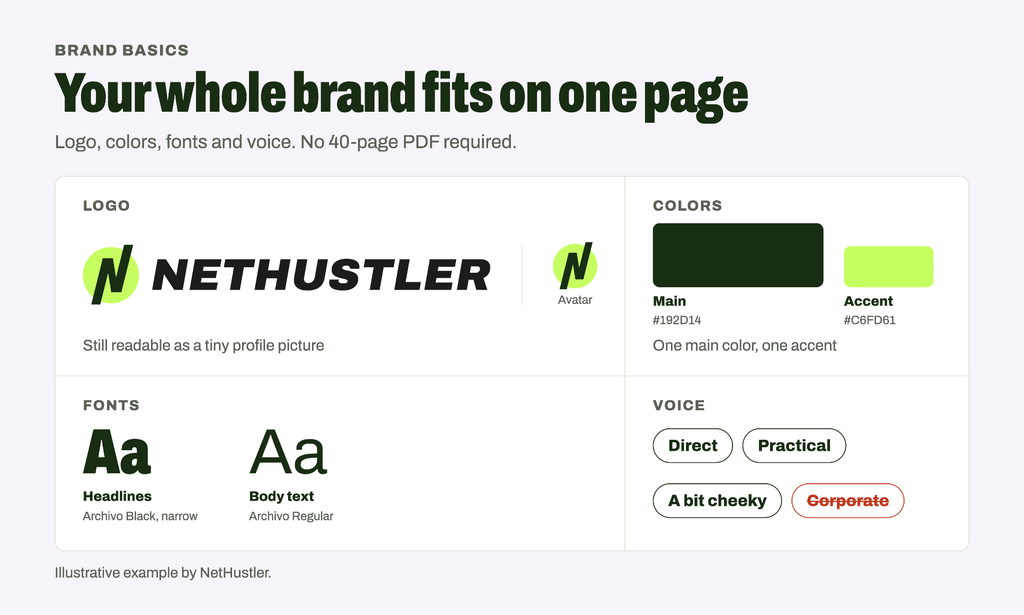
- Find your voice. Pick three adjectives for how you sound and one thing you’re not. NetHustler, for example, is direct, practical, and a bit cheeky, but never corporate.
- Keep the visuals simple. If a drunk toddler can’t draw your logo, it’s too complicated. Choose a color scheme wisely: unless you’re selling unicorn vomit, maybe cool it with the rainbow palette. Font also matters: don’t use 4 different fonts on your site; keep it at 2 maximum.
Step 3: Set up your home base (own it, don’t rent it)
Time to stake your claim in the digital wild west.
- Create a Website: Make it sleek, make it fast, and make sure it doesn’t look like it was built in 1999. But don’t just add stuff just to make it stand out. Simplicity is also key. We’ve a detailed breakdown about how to set up your own website.
- Social Media Profiles: Be everywhere your audience is. But don’t just use the same bio on every platform. That’s just lazy. Same goes for the content. Different platforms require different formats of content, some longer, some shorter, etc. Pick two platforms, not seven, and browse our social media guides for platform-specific tips.
- Email List: Start building it now. Your email list is the one audience no algorithm can throttle, so start building your email list on day one.
Step 4: Create content people remember you for
Content is still king, but for a king to be great, he needs inspiration, which is where you come in:
- Pick 3 content pillars that come straight from your positioning statement, then do proper keyword research to find what people search for in each. If writing is new to you, start with these tips on how to write good content.
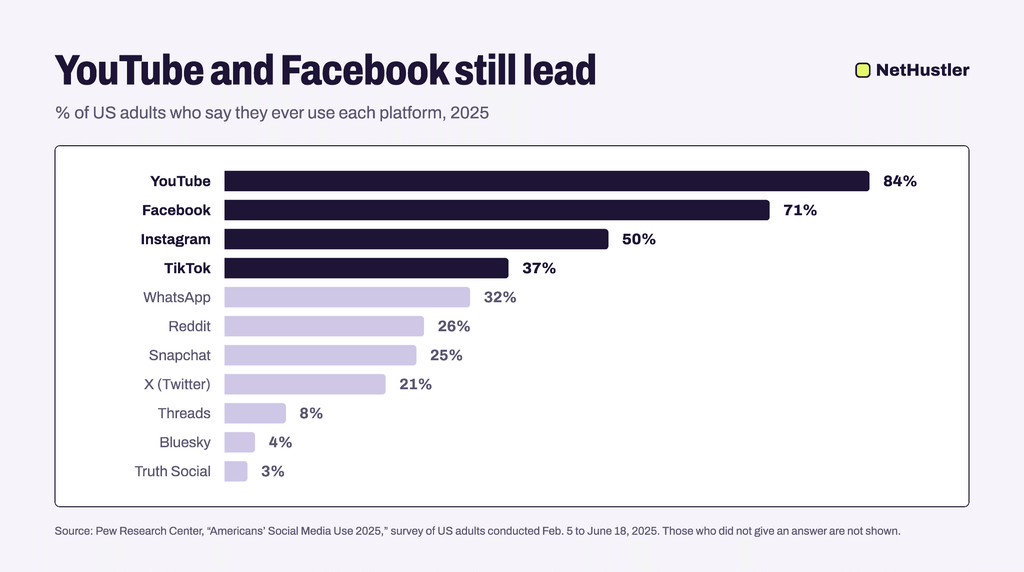
- Choose one main platform. According to Pew Research Center’s 2025 survey, 84% of US adults use YouTube, 71% Facebook, 50% Instagram, and 37% TikTok. But go where your audience is. A B2B consultant may do better on LinkedIn. Not comfortable on camera? Faceless channels work too.
- Turn one idea into five pieces: a blog post, a short video, a carousel, a newsletter, and a LinkedIn post.
Step 5: Make Google (and AI search) recognize your brand
People now get answers from Google’s AI Overviews and AI Mode before they click anything. Good news: you don’t need new tricks.
- Show real experience. Google’s guide on how to create a helpful content looks for first-hand expertise and a clear author. Add a real bio and your own screenshots.
- Skip the AI hacks. Google’s AI features page says no special markup is needed for AI Overviews or AI Mode, and its generative AI guide says to be original.
- Earn links, don’t buy them. Paid links break Google’s spam policies. Try to create genuinely useful content, publish niche relevant statistics and reach out to niche journalists to land backlinks that are earned, not built.
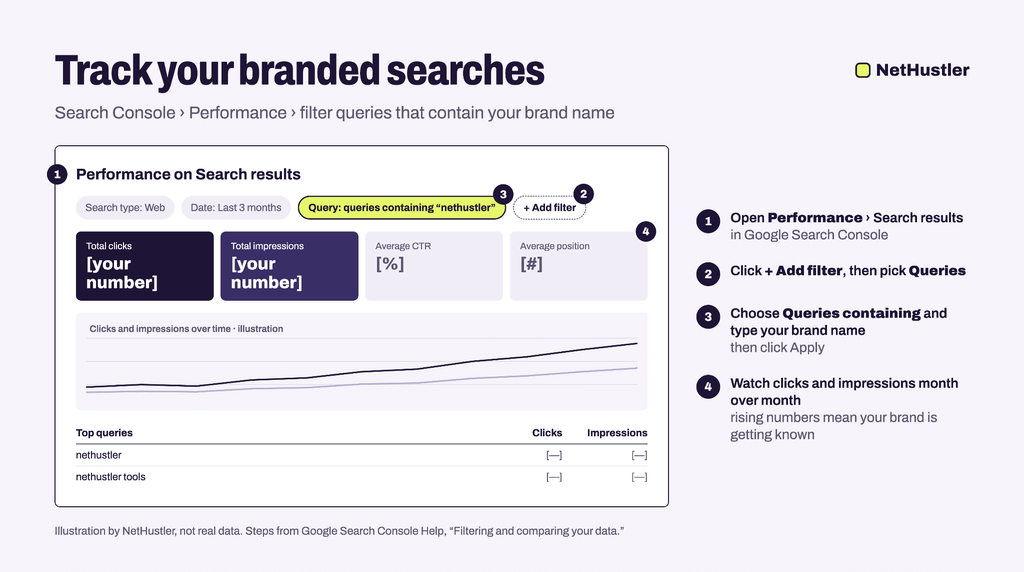
- Track branded search with the Queries containing filter in Search Console. More searches for your name means it’s working.
Step 6: Get your first real traffic
Now that you’ve got everything together, it’s time to get people to actually see it.
- Paid Ads: Sometimes you gotta pay to play. Just don’t blow your life savings on clicks from bots. I mean, you will pay for bots anyway, so be prepared for that and budget accordingly. Start with a daily budget you’d be fine losing. On a tight budget, try cheap traffic sources that still work.
- Influencer Partnerships: Find someone with a bigger audience and piggyback on their success. It’s not lazy; it’s strategic.
- Email Marketing: Sliding into inboxes is still cool, as long as you’re not spammy about it.
Step 7: Turn attention into trust
Congrats, you’ve laid the groundwork! You know what? I like the saying that traffic is people seeing you once and brand awareness is people remembering you next time.
- Consistency is Key: Show up regularly with your content. Be like that annoying friend who always wants to hang out, but, you know, less annoying.
- Engage Like Your Life Depends on It: Reply to comments, jump into discussions, and be a human being on the internet (a rare sight these days).
- Collaborate and Cross-Promote: Team up with other brands. It’s like speed dating, but for business.
And finally! Putting It All Together
Hey look at you, you have reached the end of this article. Well done. Seriously, I’m not even joking, because with the short attention span that we have today thanks to 3-4 second reels, it’s a bit hard to focus and finish reading something from top to bottom (that is, of course, if you haven’t just skimmed through it all; if you did that, well, congrats as well).
At the end: how to tell if your brand is growing…
Check these once a month: branded searches in Search Console, direct and returning visitors, email subscribers, and mentions or reviews. To benchmark against competitors, use these tools to check website traffic. Don’t obsess over follower counts.
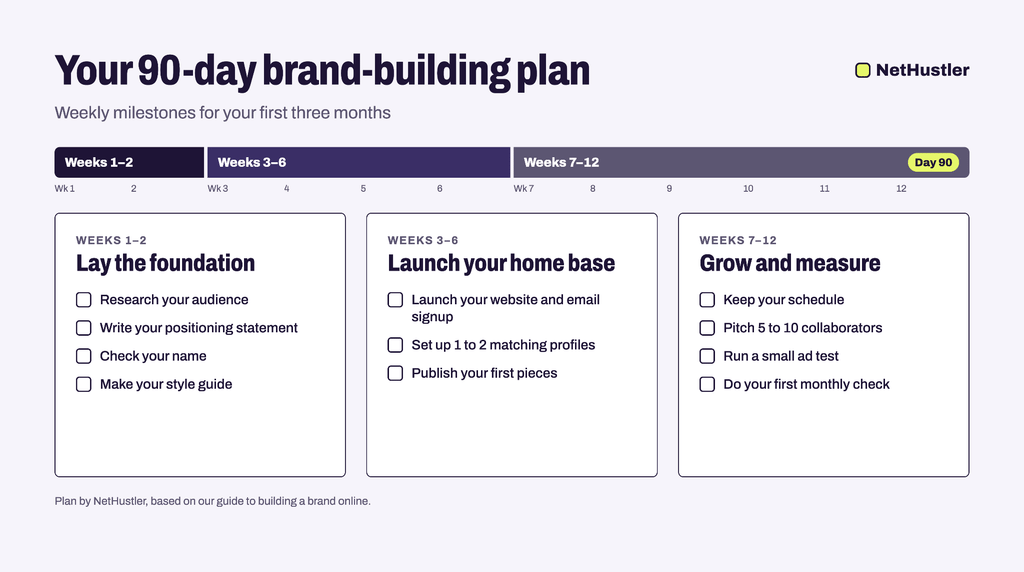
GIFT-GUIDE: Your first 90 days
Save this guide from Nethustler, print it out, keep it handy, and enjoy your journey!
Now go build something people remember.
Frequently asked questions (FAQ)
1. How do I tell if my niche is specific enough?
If you can’t describe your brand in a single sentence, then you are too broad. “Everyone” is not an audience. Read Reddit threads, comments on competitors top YouTube videos and 3-star reviews on Amazon or G2 to find the exact problems and phrases your audience uses.
2. How many fonts and colors does my brand need?
Keep it simple: max two fonts, restrained color scheme. If you can’t draw your logo from memory, then it’s too complex.
3. How many social media should I start with?
Two, not seven. Wherever your audience is already spending time, go there and adapt your bio and content format to each platform, instead of simply copy and pasting.
4. Do I need to do any special tricks to get into Google AI Overviews and AI Mode?
No. Google says no special markup required. First-hand experience, original content, a clear author bio, and your own screenshots are a must. Buy links, don’t earn them, because paid links violates Google’s spam policies.
5. How Much Should I Spend on Paid Ads When I’m Just Starting Out?
Start with a daily budget that you can afford to lose. Expect to lose some spend on bot clicks, and if your budget is tight, look at cheaper traffic sources, influencer partnerships or email marketing.
6. How can I determine if my online brand is growing?
Check the following on a monthly basis: branded searches in Search Console (using the “Queries containing” filter), direct and returning visitors, email subscribers, mentions/reviews. Drop the number of followers.