9 Amazon Side Hustles Worth Trying (With Real Costs and Earnings)


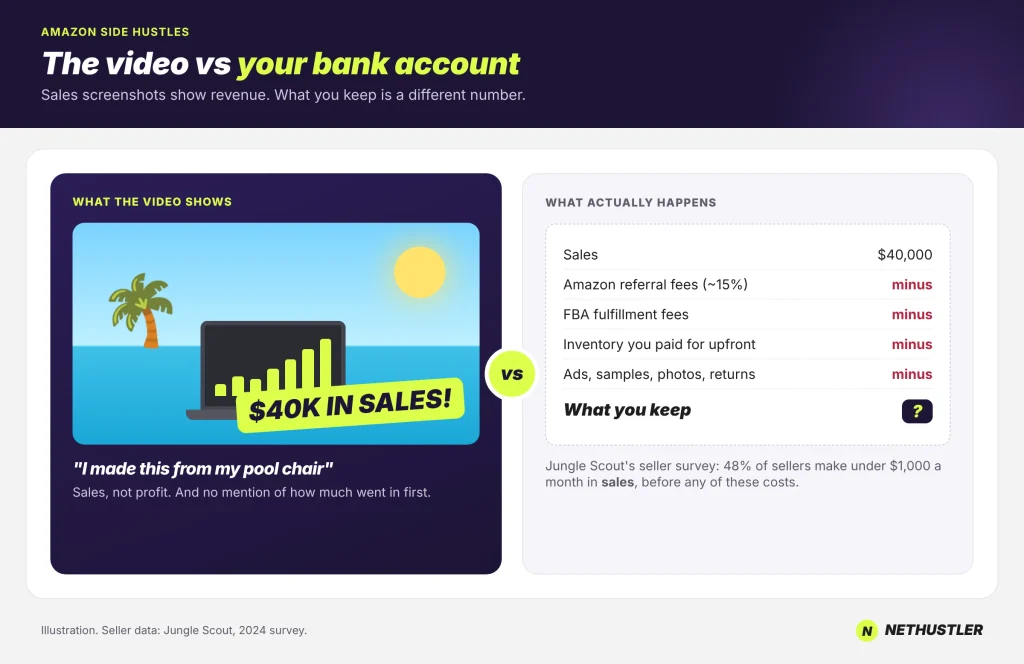
Every “Amazon side hustle” video seems to open the same way, a screenshot of huge sales and a laptop next to a pool.
Then you check Reddit and find a thread literally titled “Amazon isn’t a side hustle”.
They are talking about different things.”Making money with Amazon” can mean delivering packages on a Tuesday nite or importing 500 yoga mats from a factory. One pays you this week. The other can eat up your savings before it pays you anything.
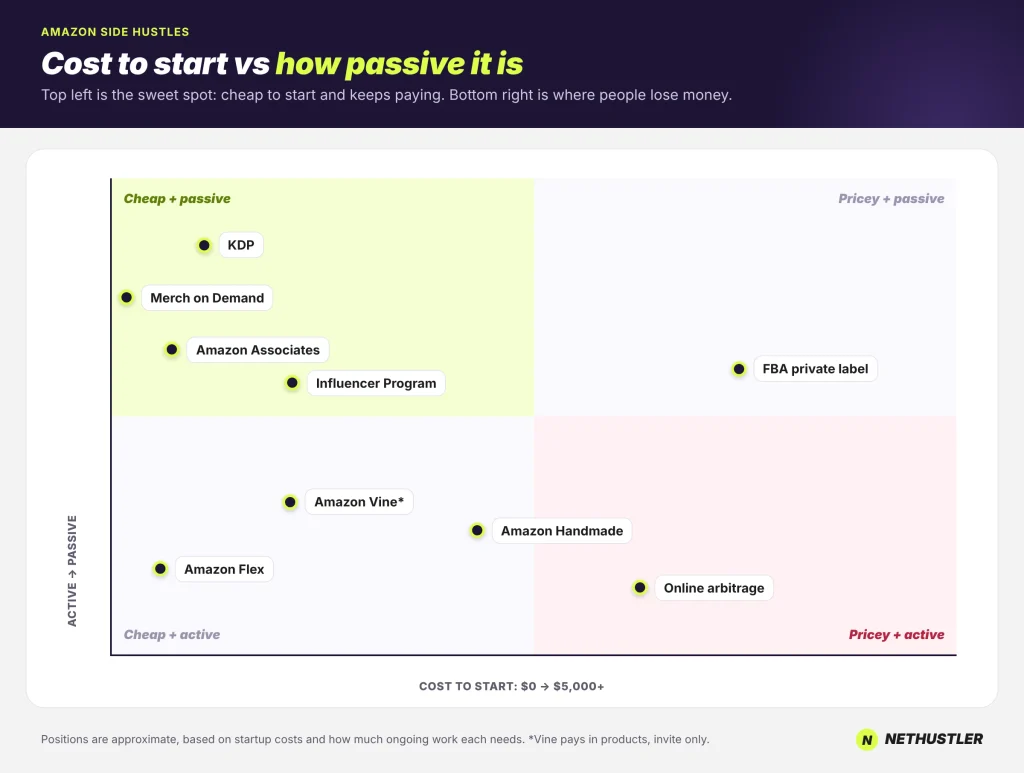
So, no dream pitch here. Here are 9 real ways to make money with Amazon, organized by what you need to begin: a car, an audience, a skill, or cash. For each one, you’ll see how much it costs, how the money works, what it takes to make an extra $500 a month, and one thing you can do today. All numbers are from Amazon’s own pages or a named source, and were verified October 2026. Note: This guide is US-based so some programs may not be available or work differently outside the US.
If you just want the answer: Amazon Flex is the fastest way to make money this week. Associates, KDP and Merch on Demand cost nothing to start and can keep paying later. FBA only makes sense if you have savings you can afford to lose.
And if any guide still tells you to sign up for Amazon Mechanical Turk, close the tab. Amazon shut MTurk down for good on September 30, 2026.
What $500 a month actually takes
Forget “earn up to” claims. Here’s what an extra $500 a month looks like with each hustle, using real rates:
| Side hustle | Cost to start | What $500 a month takes |
|---|---|---|
| Amazon Flex | $0, plus your car | About 6 delivery blocks (around 23 hours) at the average rate, before gas |
| Amazon Associates | $0 | About 223 sales of a $50 kitchen item at 4.5% |
| Amazon Influencer Program | $0 | Hard to predict: Amazon decides whose videos get shown |
| Kindle Direct Publishing | $0 to a few hundred | About 144 ebook sales at $4.99, or 125 paperbacks at $15 |
| Merch on Demand | $0 | About 205 t-shirts at the reported $2.44 royalty |
| Amazon Handmade | $39.99 for the first month | About 15 sales of a $40 item, before materials and shipping |
| Online arbitrage | $39.99 a month plus stock | 100 items if you clear $5 each after fees |
| FBA private label | Most start with under $5,000 | Months of setup first. Almost half of sellers make under $1,000 a month in sales |
| Amazon Vine | $0, invite only | Can’t be done: it pays in products, not cash |
These are examples of scale, not promises. But they tell you much. Flex gets you there in a couple weekends. The others need a lot of sales or a lot of time till the money comes.
If you’ve got a car
1. Amazon Flex
Flex is the closest Amazon comes to ‘show up, get paid’. You pick up a delivery block in the app, load up your car at a station and deliver packages. Regular Amazon.com blocks are 3 to 6 hours long, Amazon Fresh grocery blocks are 2 to 4.
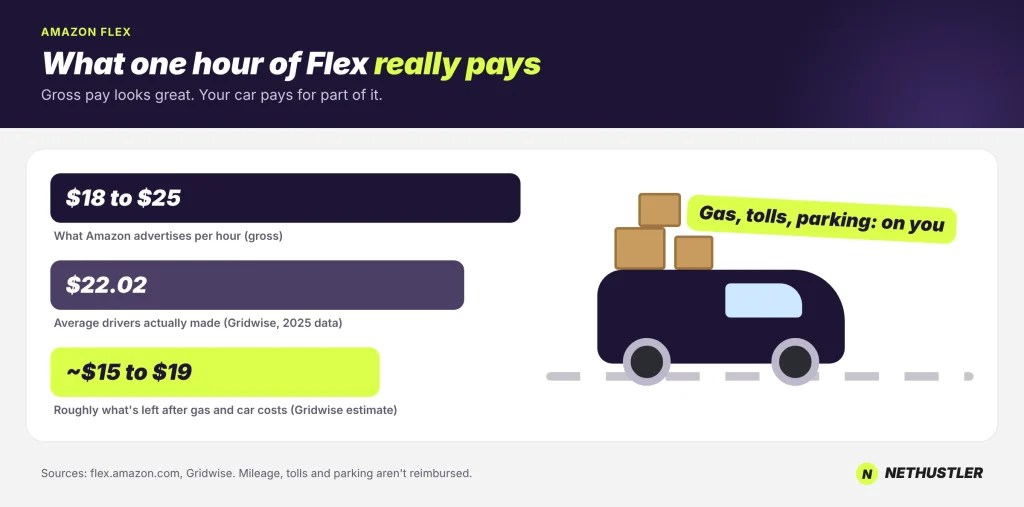
Amazon says most drivers earn up to $18 to $25 an hour, plus 100% of tips. Gridwise, which tracks gig driver earnings, measured an average of $22.02 an hour, or $86.23 per block, in 2025. You can cash out daily.
As for the small print, that figure refers to gross pay and you have to pay for gas, parking, tolls and the wear and tear on your car, and Gridwise estimates that drivers end up with about $15 to $19 an hour after having paid for their car expenses. Since you’re working as a contractor, no taxes are deducted from your pay. Therefore, you should set aside some money every week and keep a record of the miles you drive, as business mileage is generally deductible (though you should consult a tax professional).
To qualify, you need to be 21 or older, with a US driver’s license, a clean background check, a 4-door midsize sedan or bigger, and a phone running iOS 17 or Android 14.
So, is Amazon Flex a good side hustle? For quick cash, yes. For something that grows, no. The money stops the minute you stop driving.
If you don’t have a car, and you search for ‘Amazon side hustle jobs’, Amazon also recruits people for part-time and seasonal positions in its warehouses. These are standard hourly jobs with wages that vary according to your location.
Do this today: check whether Flex is hiring in your city before you get attached to the idea. In busy areas, blocks get snapped up fast.
If you’ve got an audience (or want to build one)
2. Amazon Associates
If you run a blog, have a YouTube channel, send out a newsletter or even maintain a good Pinterest account, then Associates is the obvious course to follow. You include links to Amazon products and you receive your commission when a purchase is made within 24 hours.
The cut is small, though. Most categories pay 3% to 4.5%. Luxury beauty pays 10%. Grocery and health pay just 1%. So a $50 kitchen gadget at 4.5% earns you $2.25, and you’d need about 223 of those sales to make $500 a month.
Two rules catch a lot of beginners:
- After joining, you will have 180 days to make 3 qualifying sales or Amazon will close your account. Buying through your own link or having your mom buy is not counted.
- Since April 2026, sales from paid or boosted ads don’t count, and your content has to add something original, like a real review or comparison.
That second rule kills the lazy version of the “Amazon Pinterest side hustle”, where people pay to boost pins full of affiliate links. Organic pins with real content still work.
Think of Associates as a way to get paid for content people already find. It won’t bring you traffic on its own. If you’re new to this, my affiliate marketing guide covers the basics, and here’s how to do affiliate marketing without a website.
And if 1% to 4.5% feels low, other affiliate networks often pay more for the same kind of content. Whichever you join, track your affiliate links from day one so you know which posts actually earn.
Do this today: make one honest “best X for Y” post or video about something you actually own and use. That’s the kind of content these links convert on.
3. Amazon Influencer Program
Influencer Program is Associates for people who make videos. You apply with a YouTube, Instagram, TikTok, Pinterest or Facebook account, and Amazon looks at your content, engagement and followers. There’s no published follower minimum.
The big extra is video on site. Your product videos can appear right on Amazon product pages and you get paid when shoppers purchase after watching. Creator Connections also has paid brand deals.
The catch is that Amazon decides which videos end up on those pages, so you can’t count on it. And every Associate gets a storefront too, which was the main perk of this program until April 2026.
Do this today: if you already post product videos, apply. Worst case, you get rejected and keep using regular Associates links.
If you’ve got a skill and some evenings
4. Kindle Direct Publishing (KDP)
KDP is the closest thing to passive income Amazon offers, with one big asterisk: you have to write the book first.
Publishing is free, and the royalties are decent:
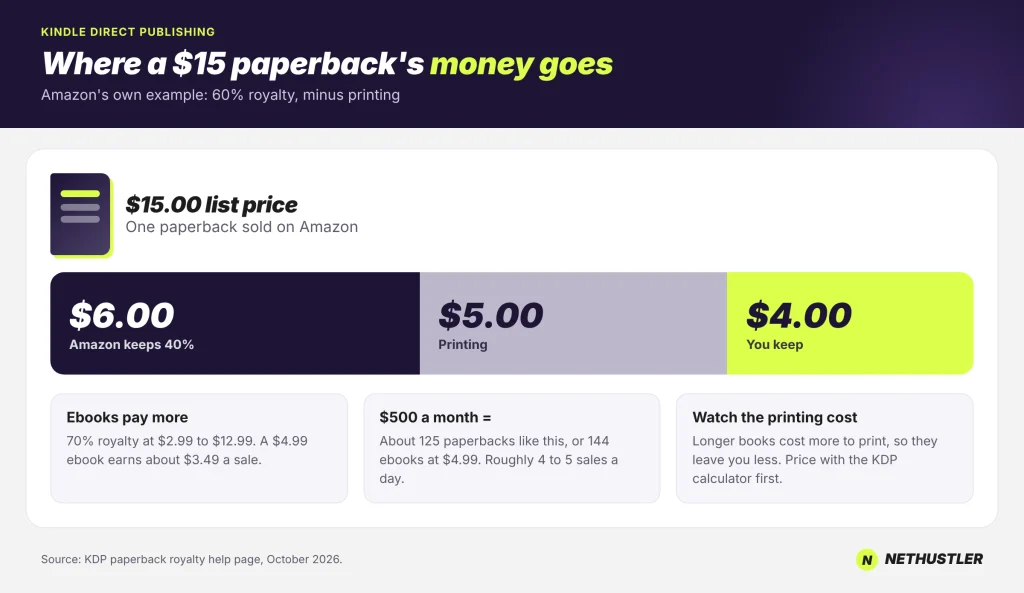
- Ebooks: 70% if you price between $2.99 and $12.99, minus a small delivery fee based on file size. The top of that range went up from $9.99 in July 2026. Outside it, you get 35%.
- Paperbacks: 60% of the price minus printing for books at $9.99 or more. Amazon’s own example: a $15 paperback with $5 of printing earns you $4.00.
- Kindle Unlimited: enroll in KDP Select and you’re paid per page read, about $0.0048 a page in April 2026 .
So a $4.99 ebook will net you around $3.49 a sale. If you sell five a day, that’s about $ 500 a month. That sounds doable until you realize that most books never sell five copies in total. The ones that do, usually solve a specific problem for a specific reader, not “a book about productivity”.
One more thing: KDP Select requires that your ebook be exclusive to Amazon, so you can’t sell it on your own site at the same time.
Do this today: search Amazon for your book idea and read the 2 and 3 star reviews of the top results. Whatever people say is missing, that’s your book.
5. Merch on Demand
You upload a design and Amazon Merch manufactures the shirt, ships it out and handles returns. No upfront cost, no inventory.
You apply with your tax and bank details and new accounts start at Tier 10 which means 10 live designs. Sell enough and you get more slots.
The money changed this year. Since June 2026, sellers and several Merch tool companies report a new three-tier royalty system based on how much of your traffic comes from outside Amazon. On a $19.99 standard tee, that’s reportedly about $2.44 for most sellers and up to $5.27 if you bring your own buyers. Amazon’s official page wasn’t available to confirm this when I checked, so look at the royalty calculator in your account before you set prices.
If those numbers are right, people who rely only on Amazon search now earn about half per shirt. Merch works best if you already have an audience to send there. My guide to starting a print on demand business covers other platforms you can run alongside it.
Do this today: apply, since approval isn’t instant, and start a list of 10 design ideas for one niche you know well while you wait.
6. Amazon Handmade
Handmade is Amazon’s answer to Etsy. If you make jewelry, candles, furniture or anything else by hand, you can sell it here.
You register as a Professional seller and then apply as a maker. Amazon takes a 15% referral fee (at least $0.30) per sale, and the $39.99 monthly fee is waived after your first month if you’re approved. So a $40 item puts $34 in your pocket before materials and shipping.
The annoying parts: you pay for that first month and can still be rejected, and custom orders can’t use FBA, so you ship those yourself.
Do this today: if you already sell on Etsy or at markets, work out the numbers on your best seller with Amazon’s 15% fee before you apply.
If you’ve got money to put in
7. Online and retail arbitrage
This is the clearance aisle hustle. You buy products cheap at Walmart, Target or other websites and resell them on Amazon for more.
It costs more than it looks. Amazon’s selling plans are $0.99 per item sold (Individual) or $39.99 a month (Professional). Then Amazon takes a referral fee on each sale, usually 15%. If Amazon stores and ships for you through FBA, add fulfillment fees. Your profit is whatever is left after all of that, not the gap between the price tag and the Amazon price.
The bigger problem is gating. Many brands and categories need Amazon’s approval, which usually means wholesale or manufacturer invoices. Store receipts typically aren’t enough. Brands can also file complaints against resellers, which can get your listings pulled.
But it’s the cheapest way to learn how to sell on Amazon before you take bigger bets.
Once you figure it out, wholesale is the next step up. You’re not hunting clearance shelves, you’re buying directly from a brand or authorized distributor. That will get you the invoices Amazon requires on gated brands, but suppliers will usually have minimum orders, so you’ll need more cash up front.
Do this today: install the Amazon Seller app and scan a few items next time you’re in a store. It shows what they sell for on Amazon and roughly what the fees would be.
8. FBA private label
This is the one most “Amazon side hustle” videos are selling. You find a product, have it made with your brand on it, ship it to Amazon’s warehouses, and Amazon handles delivery.
Jungle Scout’s survey of Amazon sellers (2024, the latest with these numbers) is more honest than most YouTube thumbnails:
- 25% started with under $1,000, and 64% with under $5,000
- 22% were profitable within 3 months, 58% within the first year
- 57% have profit margins above 10%
- 48% sell less than $1,000 a month
That last line is sales, not profit. And the survey only reaches sellers who are still around, so the people who lost money and quit aren’t counted.
Running costs include the $39.99 Professional plan, referral fees (usually 15%), FBA fees per unit (up an average of $0.08 in January 2026), samples, photos, and usually ads. Amazon does give new sellers over $50,000 in incentives, like 10% back on their first $50,000 of branded sales.
When Reddit says “Amazon isn’t a side hustle”, this is the one they mean. It’s a business, with your money tied up in inventory for months.
Do this today: before you buy a single unit, pick 3 product ideas and run them through Amazon’s revenue calculator. If the numbers only work in your best-case scenario, keep looking.
The one that pays in stuff
9. Amazon Vine
Vine is how Amazon gets reviews on new products. Members pick free items and write honest reviews. Silver members can take up to 3 items a day worth $100 or less, and Gold members up to 8 a day of any value.
Sounds great, except for two catches. You can’t apply, it’s invite-only, based on how helpful your existing reviews are, according to Amazon. And the freebies are taxable income.
Which brings me to the “Amazon review side hustle” ads. Vine is the only legit way to get something from Amazon for reviewing it. Anyone offering cash for Amazon reviews is running a scam or asking you to break Amazon’s rules.
Which Amazon side hustle would I start with?
If you need money this month, Flex. No contest.
If you can wait, I’d start with Associates or KDP. Both cost nothing, and the work you do in month one can still pay you in month twelve. Flex can’t do that. If money’s tight, here’s how to do affiliate marketing on a budget.
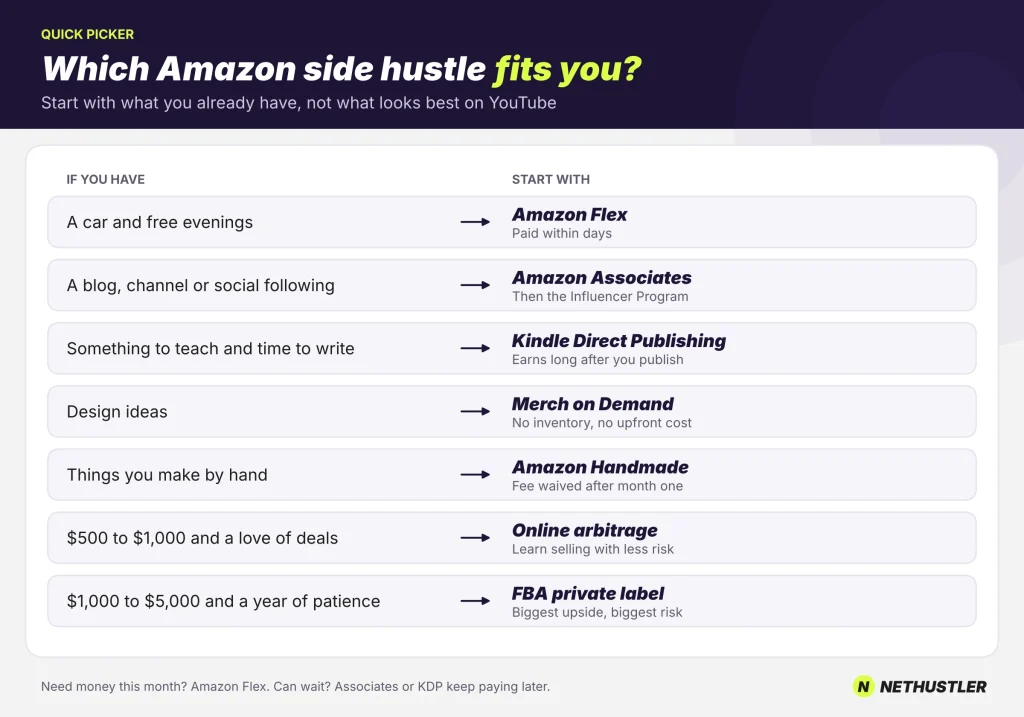
I’d leave FBA until you have savings you can afford to lose and you’ve learned the basics with arbitrage first.
| If you have | Start with |
|---|---|
| A car and free evenings | Amazon Flex |
| A blog, channel or social following | Amazon Associates, then the Influencer Program |
| Something to teach and time to write | KDP |
| Design ideas | Merch on Demand |
| Things you make by hand | Amazon Handmade |
| $500 to $1,000 and a love of deals | Online arbitrage |
| $1,000 to $5,000 and a year of patience | FBA private label |
None of these feel right? I’ve got more ideas in how to make money online and side hustles for college students.
FAQ
Do Amazon side hustles actually work?
Some do, but they work quite differently. Flex pays fast but only when you drive. Associates, KDP and Merch can earn money while you sleep, after a lot of upfront work. FBA pays the most, but it takes real money, months of effort, and many sellers never get there.
Can you make $1,000 a week with Amazon Flex?
You can, but it’s not a side hustle anymore. At Gridwise’s average of $22 an hour, $1,000 equates to roughly 45 hours of driving, not including gas.
How do I make passive income on Amazon?
Closest are KDP, Merch on Demand and Amazon Associates. Each one requires some work at the beginning (a book, some designs or content that drives traffic) and then can make money with little to no effort on a daily basis.
Is Amazon FBA a good side hustle?
Only with money you can afford to lose and time to learn. The majority of sellers surveyed by Jungle Scout began with less than $5,000, but almost half sell less than $1,000 a month.
Does Amazon pay you to review products?
No. Amazon Vine gives invited reviewers free products, not cash, and you pay tax on them. Anyone offering cash for Amazon reviews is a scam.
Which Amazon side hustle needs no money to start?
Amazon Flex (if you have a car), Associates, the Influencer Program, KDP and Merch on Demand are all free to join.
Final thoughts
The best side hustle on Amazon is the one that fits in with what you already have. A car. An audience. A skill. A little bit of savings. Buy the cheapest one that fits your needs, learn how Amazon works and put real money in only when you know what you are doing.
Stay hustlin’ and pick the one that fits you!