Is Similarweb Accurate? Here’s My Experience

Wondering how accurate Similarweb actually is? Then you will learn it in this article. Hint: it’s not as black and white as most reviews make it out to be.
Understanding Similarweb Accuracy
When I first dipped my toes into digital analytics, especially for checking out competitors where Google’s analytics is useless, my number one concern was accuracy. The burning question: how accurate is Similarweb? Let’s find out.
Similarweb vs. Competitors
Semrush and Ahrefs have been Similarweb’s biggest competitors in the digital intelligence space for years. The most exhaustive public comparison of these tools is SparkToro’s traffic accuracy study. Similarweb performs best for sites with 5K-100K monthly Google Analytics users.
The platform constructs its estimates from billions of digital signals gathered from devices, websites, and user behavior. It is often combined by marketers with their own Google Analytics for competitor analysis and traffic evaluation.
That’s how the four major providers actually compare, within the SparkToro data set of 641 sites:
| Provider | Best traffic range | Correlation with GA |
|---|---|---|
| Similarweb | 5K–100K users/month | 0.659 |
| SEMRush | All ranges | 0.790 |
| Datos | Small sites | 0.720 |
| Ahrefs* | Organic search only | 0.504 |
*The Ahrefs tool only estimates organic search traffic, not total traffic, so it’s apples to oranges to compare it to total-traffic tools. SparkToro recognized this in a follow-up update to the original study..
Two things to note. SEMRush actually had the highest overall correlation with GA across the full dataset, so if you care about directional accuracy (is traffic going up or down?) SEMRush wins. But Similarweb wins on the metric that actually matters to most marketers: the frequency that the estimate is within ±30% of the actual number. This is especially the case for sites in the 5K–100K traffic band.
If you want to know how Similarweb collects its data, check out how Similarweb estimates traffic.
Exploring Independent Research
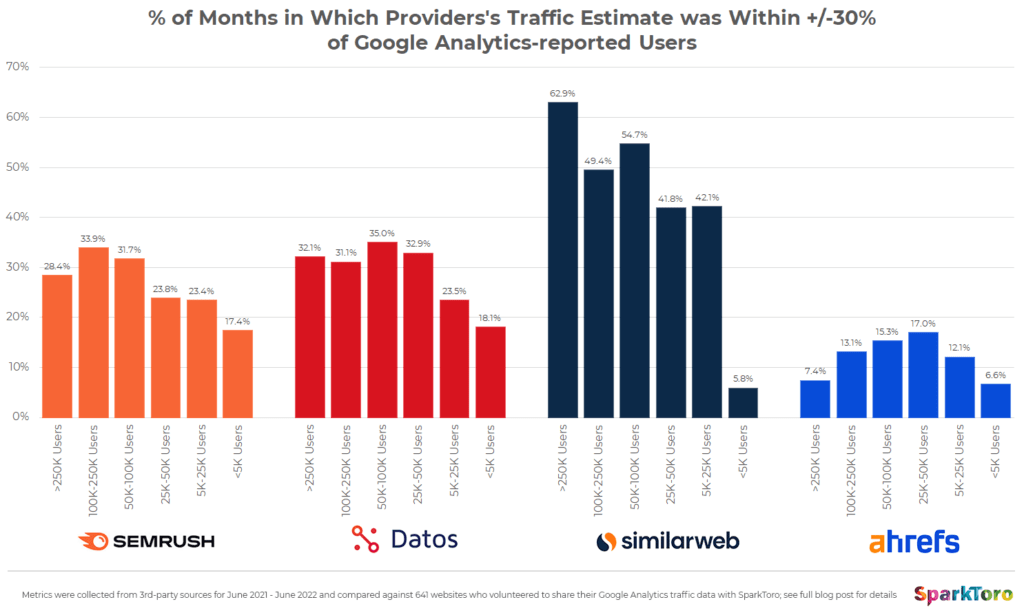
The SparkToro study is still the most rigorous independent look at how accurate Similarweb is. Some key take-aways:
- For sites with 250K+ monthly GA users, Similarweb hits within ±30% of the actual number 62.9% of the time, which is the highest of any tool tested
- For sites with 5K–100K monthly users, Similarweb is the most accurate tool of the four studied.
- When it came to sites under 5K monthly users, Similarweb’s estimates were the worst of the bunch, overestimating more often than any competitor in that range.
SparkToro came to the simple conclusion: “no 3rd party estimate today is consistently accurate enough to place high confidence in their numbers.” That’s the honest answer most reviews don’t give. Similarweb is the best of the imperfect options, not a perfect tool.
That accuracy is a product of Similarweb’s big-data approach. It taps into a network of consumer behavior built on millions of websites and apps that share their first-party analytics, telecom partnerships, public web crawling and machine learning models that fill in the gaps.
My Experience With Similarweb’s Data Accuracy
The research from SparkToro mirrors my own experiences. Similarweb is pretty good on bigger sites, but the numbers get sketchy fast on smaller ones.
I’ve tested it on smaller sites and Similarweb overstates traffic by 2-3x compared to actual Google Analytics data. For example, a site that is showing about 3K visits per month in GA will be shown as about 8K in Similarweb. That’s a 2.6x overestimate, consistent with SparkToro’s finding that Similarweb is least accurate on sub-5K-user sites.
I’ve seen 20-30% overestimates pretty often even on bigger sites. It’s not great, but it’s not bad enough to make the tool useless. And that 20-30% range tracks with SparkToro’s ±30% accuracy window for big sites.
Is the data perfect? So. Nope. Does it help? Yes, but with the right expectations. It is still one of the best digital marketing tools to analyze a competitor’s website. You just have to take the numbers as estimates, not word of God. If you treat Similarweb data as a directional signal, not a precise count, it’s a really useful research tool.
The accuracy problem mainly affects smaller sites with less traffic data. It’s a credible tool for analytics on medium and high-traffic websites whether I’m checking out the competition or putting together a content strategy.
Features of Similarweb PRO
Similarweb Pro has a ton of advanced tools that can help internet marketers like me to maximize their analytics data. A few highlights to be aware of, particularly in terms of SEO capabilities vs Semrush.
SEO Analysis Capabilities
Similarweb isn’t always accurate, but it has some pretty good SEO tools. They help you search for keywords your site ranks for and display your SERP position. And they provide you with a detailed view of where you stand against competitor sites.
Similarweb PRO lets you:
- Trace your keywords
- Verify your SERP rankings
- Examine your backlink profile
That said, most marketers find Semrush better for SEO in particular. Semrush offers a broader set of tools to track backlinks, research keywords and analyze on-page SEO.
| Feature | Similarweb Pro | Semrush |
|---|---|---|
| Keyword tracking | Yes | Yes |
| SERP position | Yes | Yes |
| Backlink analysis | Limited depth | More comprehensive |
| Historical data | Limited window | Up to a full year |
| Geo coverage | Limited regions | Global |
Competitive Website Comparison
Similarweb Pro really shines for competitor analysis. Knowing what’s working in your space and where competition is gaining ground helps. See where you stack up on traffic, user engagement and keyword performance.
The Competitive Analysis feature surfaces:
- Traffic trends over time
- User engagement metrics
- Top-performing pages on competitor sites
- Country-level traffic breakdowns
This intel gives you a roadmap to see what you’re doing right, and where competitors are pulling ahead. Semrush is more generous as far as the number of reports. Their Pro plan allows 3,000 domain and keyword reports per day, compared to Similarweb’s 1,000.
| Parameter | Similarweb PRO | Semrush |
|---|---|---|
| Traffic trends | Yes | Yes |
| User engagement | Yes | Yes |
| Top pages | Yes | Yes |
| Geo data | Yes | Global |
| Daily report limit | 1,000 | 3,000 |
Want to see what Similarweb actually costs? Check out my rundown on how much Similarweb costs.
Data Methodology and Accuracy
The regularity of the data collection and updating directly affects the precision of the figures. This is how Similarweb deals with both.
Data Collection Sources
Similarweb pulls data from several sources to build its estimates:
- First-party analytics: Sharing analytics through partnerships, SDKs, and integrations with websites and apps
- Consumer behavior network: Data from users who have signed up to data sharing via certain apps
- Global partnerships: Advertising partners, telecom firms and other large-scale data providers
- Public web crawling: Automated bots scan publicly available web pages, metadata and rankings
- Machine learning models: AI systems that build full traffic estimates from raw data and complete the picture
Data Refresh and Release Schedule
How often Similarweb updates its data matters for accuracy. The cadence:
| Data update | Frequency |
|---|---|
| Daily refresh | Midnight EST |
| Monthly data release | By the 10th of the following month |
So sometimes Similarweb data can feel lagging. You’re doing traffic checks for last month and today is the 5th of this month, new numbers are not out yet.
You need to know how Similarweb collects and refreshes data to read its numbers properly. The estimates are not picked out of the air. These are modeled from real signals. But these are still guesstimates.
Similarweb for Decision-Making
You need reliable data to make real decisions for Internet marketing work. That’s how Similarweb makes its money, accuracy caveats aside.
Fortune 500 Reliance
According to Similarweb’s own investor materials, half of the Fortune 500 use the platform alongside hundreds of investment funds for digital intelligence and market insights. That level of enterprise adoption speaks to the trust in the platform to understand online trends, competitors and audience behavior, even with its limitations on smaller sites.
Similarweb and AI Search Visibility
As AI-powered search continues to develop, Similarweb has become useful for tracking visibility across digital channels outside of traditional Google.
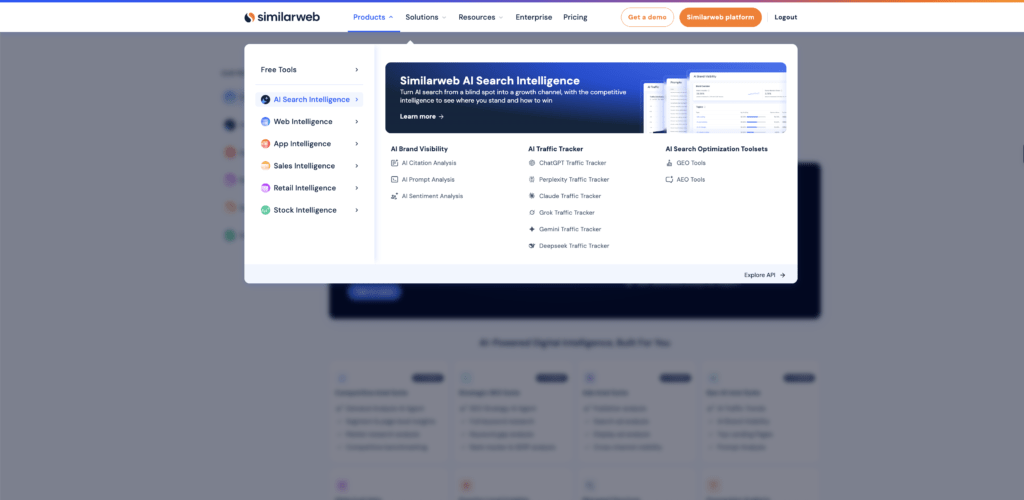
Marketers can track traffic sources, analyze audience behavior, and monitor referral channels, including how visitors land from social platforms like Pinterest, Instagram, Twitter, Facebook, and LinkedIn. Most SEO tools only care about Google traffic. That misses a huge part of how people actually find websites in 2026.
This allows you to see how competitors are staying visible across the entire search and social landscape – not just Google.
Advanced Data Analysis
Similarweb uses AI and machine learning models to clean and classify data and build market predictions. Its visibility into traffic sources other than search is where it differs from competitors. You can see exactly how much traffic a site is getting from Pinterest, Instagram, Twitter or Facebook that most SEO tools can’t show you.
So, is Similarweb accurate?
The honest answer: Similarweb is the most accurate third party traffic estimator out there but no third party tool out there is fully accurate, including Similarweb.
It’s the most robust feature of any tool we tested in SparkToro’s research of sites with 5K–100K monthly users. On larger sites it is within ±30% of the actual figures about two-thirds of the time. Best in class but still wrong more than a third of the time. For smaller sites (<5K monthly users), Similarweb is not reliable and will most likely over estimate your traffic by 2-3x.
It is a useful tool for competitor research and market analysis. Think of the numbers as ballpark figures for direction, not precise counts, and don’t trust them at all on small sites.
FAQs
Is Similarweb accurate?
In general, Similarweb is fairly accurate in its estimates of traffic trends and how well competitors are doing on medium to large sites. SparkToro’s 2022 study shows that on sites with 250K+ monthly users, Similarweb’s estimates are within ±30% of Google Analytics about 63% of the time. That’s the best accuracy of any major third-party tool, but it’s not 100%.
Why does Similarweb overestimate traffic?
SimilarWeb does not have access to a website’s analytics so it relies on modeling and statistical estimations, which leads to overestimation of traffic. The smaller the site, the less data Similarweb has to analyze. This is why estimates on small sites tend to be so off.
Is Similarweb accurate for small websites?
No. SparkToro’s research found that Similarweb is least accurate for sites with less than 5,000 monthly users. I have seen Similarweb over estimate traffic on a small site by 2-3x. They showed 8000 visits on a site that really only gets 3000.
Is Similarweb better than Semrush?
It depends on what you are measuring. In fact, Semrush beats Similarweb on raw correlation with Google Analytics across all site sizes (0.790 vs 0.659 in SparkToro’s study). If you need absolute traffic accuracy in the +-30% range, Similarweb tends to do better for mid-size and large sites. Semrush is more all-around for SEO research (keywords, backlinks, technical SEO) specifically.
How does Similarweb collect data?
Similarweb’s data is derived from analytics partnerships, browser extensions and apps, public web crawling, telecom and global partners, and machine learning models that combine all of these signals into traffic estimates.