6 Best Similarweb Alternatives in 2026 (Free & Paid)


I saw a reddit post that summed up the problem nicely. Someone was on a similarweb trial for just two things: seeing how much traffic a site gets, and which sites send it that traffic. They were looking at about $200 a month for that, mostly for features they’d never use.
If this sounds like you, then this post is for you. I’ll tell you what to use instead, what each tool is actually good at, and how far off their numbers can be.
Quick answer: The nearest Semrush with its Traffic & Market add-on is a similar tool to Similarweb as it’s the only other tool that estimates a site’s total traffic and where it comes from. If you care more about SEO, then Ahrefs is the better choice. And if you don’t want to spend any money, a free Semrush account plus Similarweb’s free extension will take care of most small research jobs.
Here’s the short version by situation:
- Free: a free Semrush account, Similarweb’s free extension, and Ahrefs’ free Traffic Checker.
- You only need traffic and traffic sources: Similarweb’s own entry plan ($125 a month, billed yearly) is actually cheaper than the Semrush setup that does the same job.
- SEO and backlinks: Ahrefs.
- Competitors’ Google Ads: SpyFu.
- On a budget: Ubersuggest ($29 a month) or Serpstat ($50 a month).
Why the numbers never match
Before you start picking tools you need to know this or the numbers will drive you crazy.
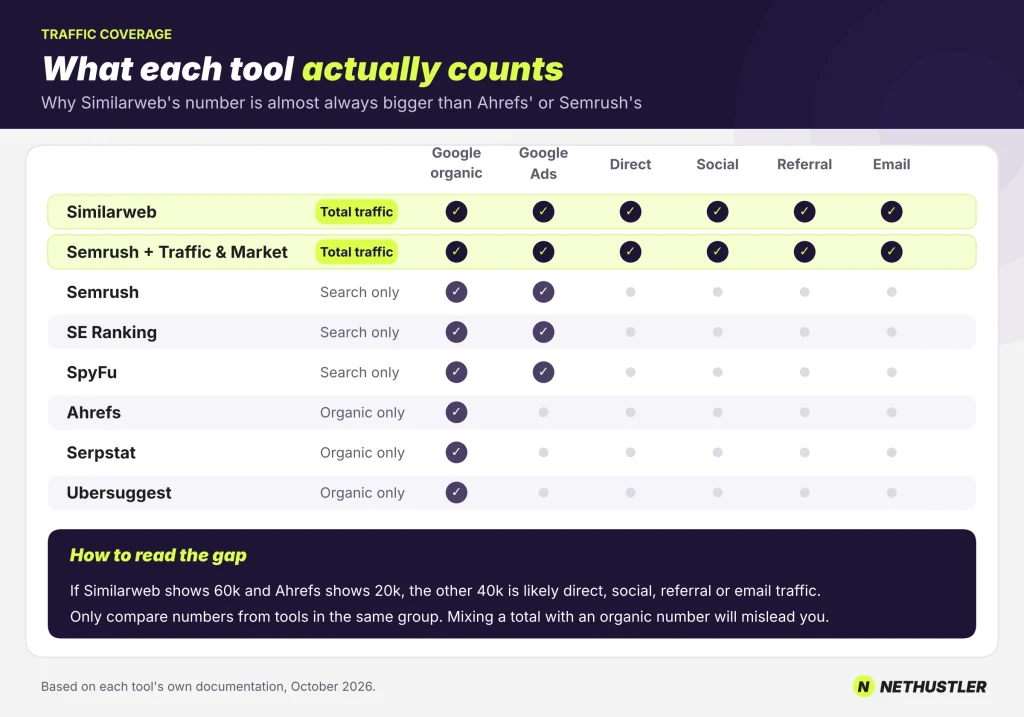
Similarweb tries to get you all the traffic on a site. This includes Google, people typing in the URL, social media, other sites linking to it, ads. It compiles that number from a combination of sources: anonymous data from browser extensions and apps on millions of devices, data from site owners who link up their analytics, public web data and partners like internet providers (Similarweb’s own explanation).
Ahrefs, Semrush (without the add-on), SE Ranking, Serpstat and Ubersuggest estimate Google search traffic. They look at all of the keywords a site ranks for and take that keyword’s search volume and guess at how many clicks that site gets based on its position. Altogether, that’s called “organic traffic.”
So when Ahrefs says a site has 20,000 visits a month and Similarweb says 60,000, they can both be right.
How accurate are these tools? (Real numbers)
Not very, and they don’t win every time.
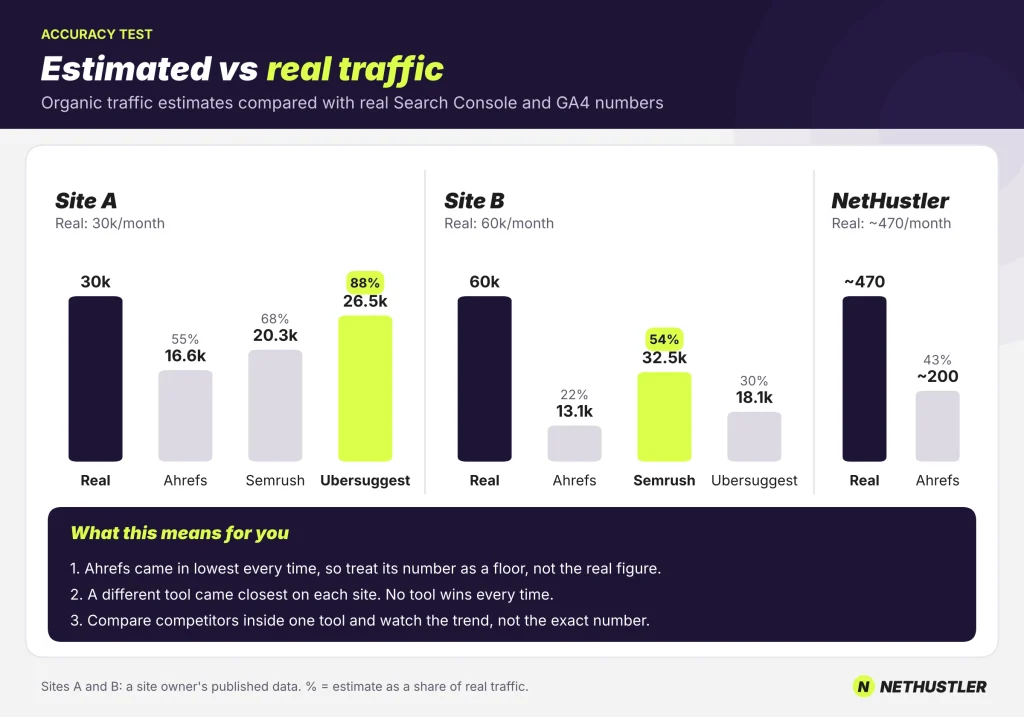
I started with my own website. Google Search Console shows NetHustler got 467 clicks from Google over the last 4 weeks. Ahrefs estimates around 200 organic visits a month. That’s less than half of it.
Then I looked for people who had done the same check as me. One Reddit site owner posted the real organic traffic for two sites next to the tool guesses:
| Site | Real organic traffic (GSC/GA4) | Ahrefs | Semrush | Ubersuggest |
|---|---|---|---|---|
| Site A | 30,000/month | 16,600 | 20,300 | 26,500 |
| Site B | 60,000/month | 13,100 | 32,500 | 18,100 |
| NetHustler (my site) | about 470/month | about 200 | not checked | not checked |
Just look at that for a second. Site A was the closest using Ubersuggest (the cheapest tool). It did Semrush on Site B . Ahrefs was always the lowest and on Site B it was guessing less than a quarter of the real number.
Total traffic estimates aren’t safer. Another site owner compared their own Google Analytics with Similarweb and Semrush. Similarweb showed about 4 times more visits than they really had, while Semrush’s visit count was very close. Both tools got the bounce rate wrong by about 3 times.
So what do you do with that? Two rules:
- Compare competitors inside the same tool. If Semrush reads low for one site, it probably reads low for the others too. The ranking between competitors is more reliable than any single number.
- Watch the trend, not the number. A site going from 10,000 to 20,000 in Ahrefs over six months is growing, even if the real numbers are different.
I go deeper into this in how accurate Similarweb is.
The free method: triangulate
Best advice I’ve seen on this one: you’ll never get true accuracy, so stop trying to get it. Instead, look up each competitor in a few tools and jot the numbers down side by side, assigning a confidence score to each site.
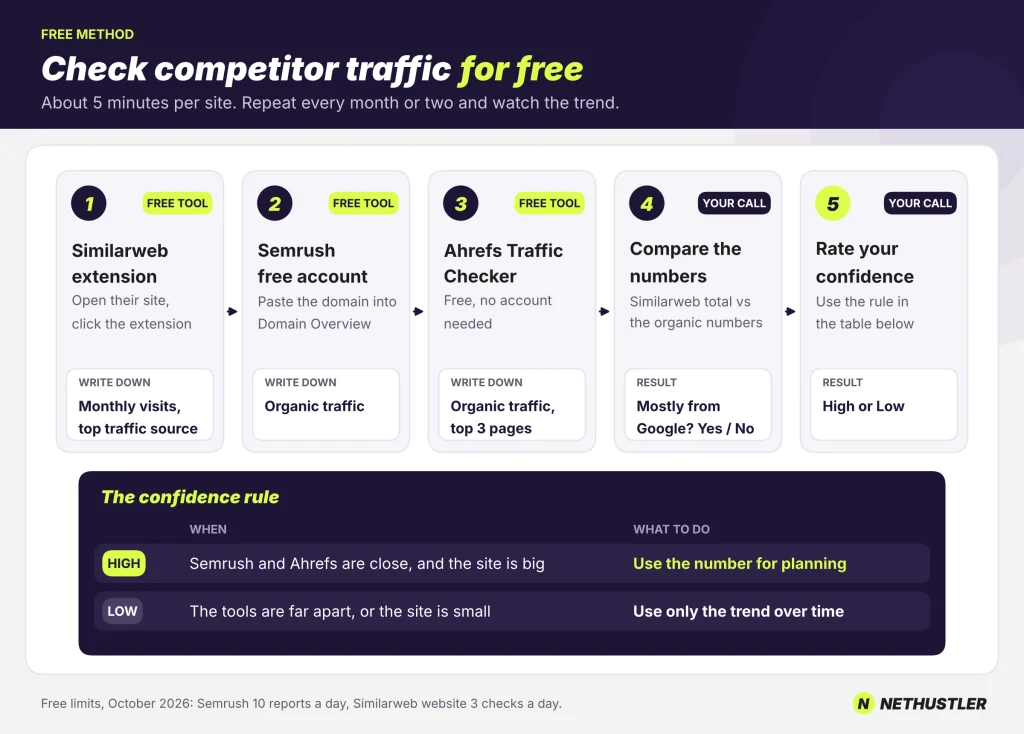
Here’s how to check traffic, for free, in about 5 minutes per site:
- Similarweb free extension. Open the competitor’s site, click the extension and note monthly visits. Also see the traffic sources chart.
- Free Semrush account. Type the domain in Domain Overview and note down the organic traffic. A few competitors can cope with ten reports a day.
- Ahrefs Traffic Checker Free. Write down organic traffic, and check the top pages. Those are the posts that generate most of its Google traffic.
- Fill in “Mostly from Google? If Similarweb’s total is close to the organic numbers, the site is living on SEO. If much higher it gets lots of traffic from social, email or direct visits.
- Give it a confidence rating. Rule of thumb for me: Semrush and Ahrefs are close to each other and the site is big, mark it high. If they are far apart or the site is small mark it low and do not lean on it.
Repeat every month or two, and the trend column becomes the most useful thing in the sheet.
Free Similarweb alternatives
| Free tool | What it shows | Limit |
|---|---|---|
| Semrush free account | Organic traffic, keywords and backlinks for any domain | 10 reports a day, 1 project |
| Similarweb website | Total visits, traffic sources, top keywords | 3 checks a day (15 with a free account) |
| Similarweb extension | Visits, rank, channels, countries, engagement | Varies, see below |
| Ahrefs Traffic Checker | Organic traffic, top pages, keywords, Domain Rating | Free, no account needed |
| Ubersuggest | Organic traffic, top pages, keywords | About 3 searches a day |
| SpyFu free plan | Organic and paid keywords | 10 results per report |
About the Similarweb extension: people report very different limits, some say there is no daily cap, others say only a few searches a week. Try it yourself, but don’t base your workflow on it being unlimited.
Two more free sources most lists forget:
- Google Trends. Compare two brand names and you’ll see whose search interest is growing. It won’t give you visits, but it’s a good sanity check on the trend.
- Meta Ad Library. Search any brand and see every ad they’re running on Facebook and Instagram right now. Free, and it’s real data, not an estimate.
How the paid tools compare
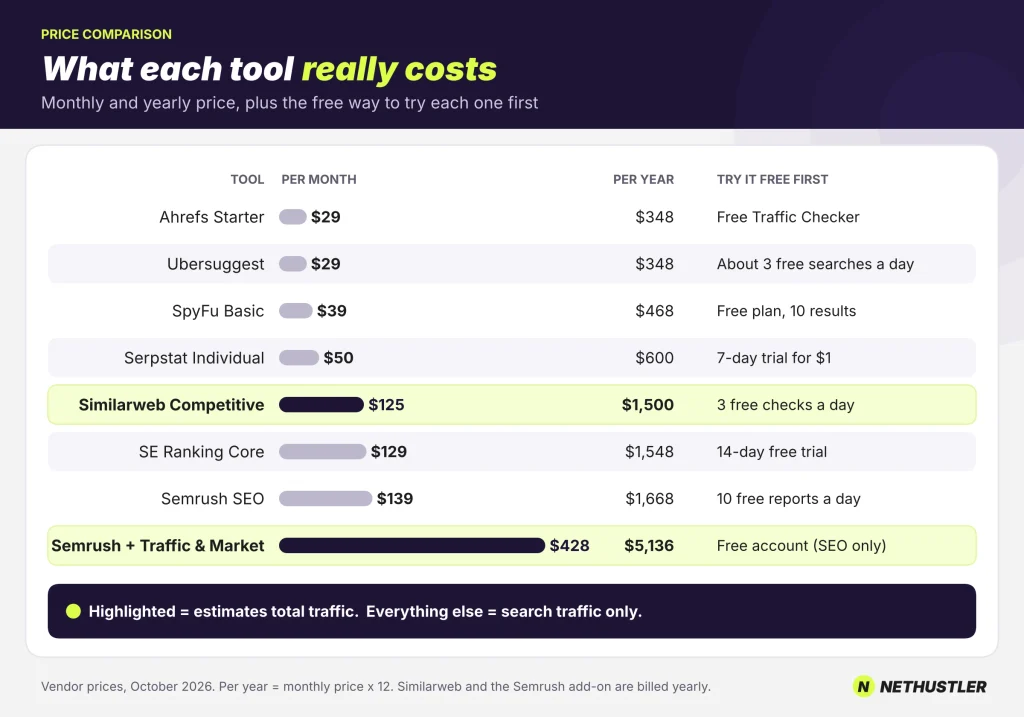
| Tool | Best for | Traffic it estimates | Free plan or trial | Monthly price from |
|---|---|---|---|---|
| Semrush | Traffic sources plus SEO | Organic and paid search; total traffic with an add-on | 10 reports a day | $139 (+$289 for total traffic) |
| Ahrefs | SEO and link building | Organic search | Traffic Checker | $29 |
| SpyFu | Google Ads research | Organic and paid search | 10 results per report | $39 |
| SE Ranking | Freelancers and small agencies | Organic and paid search | 14-day trial | $129 |
| Serpstat | Budget SEO, European markets | Organic search | 7-day trial for $1 | $50 |
| Ubersuggest | Beginners | Organic search | About 3 searches a day | $29 |
Prices are for monthly billing. Paying yearly saves roughly 15% to 35%, depending on the tool.
Paid Similarweb alternatives
1. Semrush
If you want something that works like Similarweb, Semrush is it. But only with the Traffic & Market add-on, and that’s where most reviews skip the fine print.
Open Traffic Analytics with the add-on and enter a competitor. You’ll see estimated visits, unique visitors, bounce rate, plus where the traffic is coming from (search, direct, social, referral, paid), what countries, and what pages people are landing on. Market Overview shows you which sites own a niche and which are growing fastest, while Audience Overlap shows you which other sites the same visitors use. The last one is great for finding partners or sites to advertize on.
Even without the add-on, you can still get Domain Overview: organic and paid search traffic, top keywords and backlinks. Keyword Gap and Backlink Gap show what your competitors have that you don’t, which is usually where I would start a content plan.
Now the hitch. The SEO plan is $139 a month or $117.33 if you pay for the year. Traffic & Market is another $289 a month and is billed yearly. That’s over $400 per month. If you just need traffic and traffic sources, Similarweb’s own entry plan is cheaper.
Best for: people who want traffic sources and SEO data in one tool.
Pros:
- The only tool here that estimates total traffic and channels the way Similarweb does
- Audience Overlap and Market Overview are genuinely useful for sizing up a niche
- The free account (10 reports a day) is the most generous on this list
Cons:
- Total traffic needs the add-on, which pushes the cost past $400 a month
- Overkill if all you want is a traffic number
2. Ahrefs
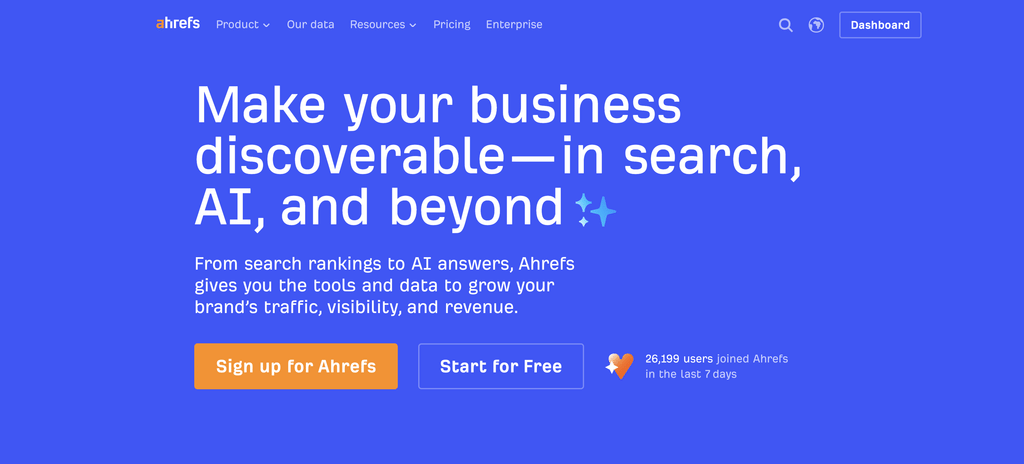
I run a link building agency so Ahrefs is open on my screen pretty much daily. This is the tool that I know best.
When I look at a competitor, I go to Site Explorer and check three things: Organic traffic trend overview. Top pages to see what posts are bringing that traffic. Organic competitors to see other similar sites I didn’t know about. Then content gap shows you keywords that your competitors rank for and you don’t.
For link building, Link Intersect is the one. It shows sites that link to several of your competitors but not to you, which makes it the easiest place to start when you’re building domain authority.
In my own workflow, I have the Ahrefs MCP connected to Claude, and life is beautiful. When I ask for something in the chat, it runs the reports inside Ahrefs for me, which makes the work about 10x faster.
The headache is the pricing. Both Starter ($29/month) and Lite ($129) have a limit on the number of reports you can run each month. If you do your research every day you’ll be on Standard for $249. Save 17% when you pay annually.
I run a link building agency, so Ahrefs is open on my screen pretty much every day. This is the tool I know best.
Best for: SEO and link building.
Pros:
- The backlink data I trust most, and Link Intersect saves hours of prospecting
- Top pages and Content gap make it fast to see what’s working for a competitor
- You can start at $29 a month
Cons:
- Organic search only, so no channel split like Similarweb
- Its traffic estimates came in lowest in the tests above
- Report limits on the cheaper plans push daily users to $249
3. SpyFu
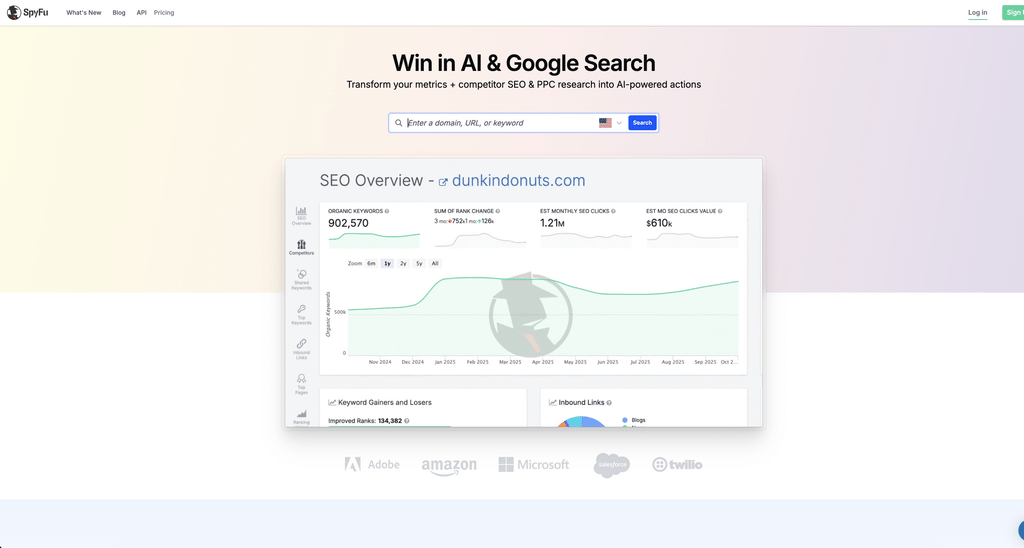
If you’re doing Google Ads, SpyFu is the first place I’d look. Its organic traffic numbers are rough, but that’s not why people buy it.
PPC Competitors shows you who is bidding on the same keywords as you and roughly how much they are spending each month. Ad History lets you see what ads a domain has run over the years, so you can see which ones a competitor kept running for months (they wouldn’t keep paying for an ad that doesn’t work). Kombat compares you to your competitors and lists the keywords you’re missing that they’re all targeting.
Basic is $39 a month and the free plan shows 10 results per report which is enough to know if it is worth paying for.
Best for: Google Ads research.
Pros:
- Years of ad history, so you can see which ads competitors keep paying for
- Estimated monthly ad spend for competitors
- Cheap at $39 a month
Cons:
- Organic traffic data is rough
- Strongest for US data
4. SE Ranking
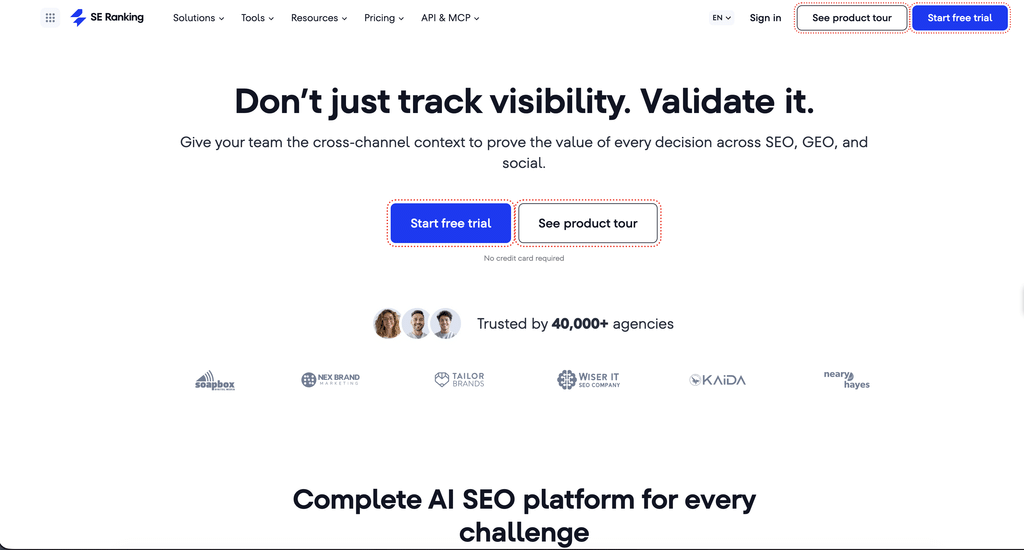
SE Ranking does most of what Semrush does for SEO for less. Competitive Research allows you to type in a domain and see the estimated organic and paid traffic, top keywords, best pages, and even sample Google Ads, filtered by country and device.
It also tracks how brands appear in AI search results, which is handy if you care about ChatGPT and Google’s AI answers.
The core version is $129 a month ($103.20 if you pay for the year) and the Growth version is $279. And the 14-day trial is no credit card.
Best for: freelancers and small agencies who want an all-in-one SEO tool for less than Semrush.
Pros:
- Organic and paid competitor data in one report
- Built-in tracking for AI search visibility
- Free trial without a credit card
Cons:
- No total traffic estimates, so it’s not a full Similarweb replacement
- $129 a month is still a lot for a solo blogger
5. Serpstat
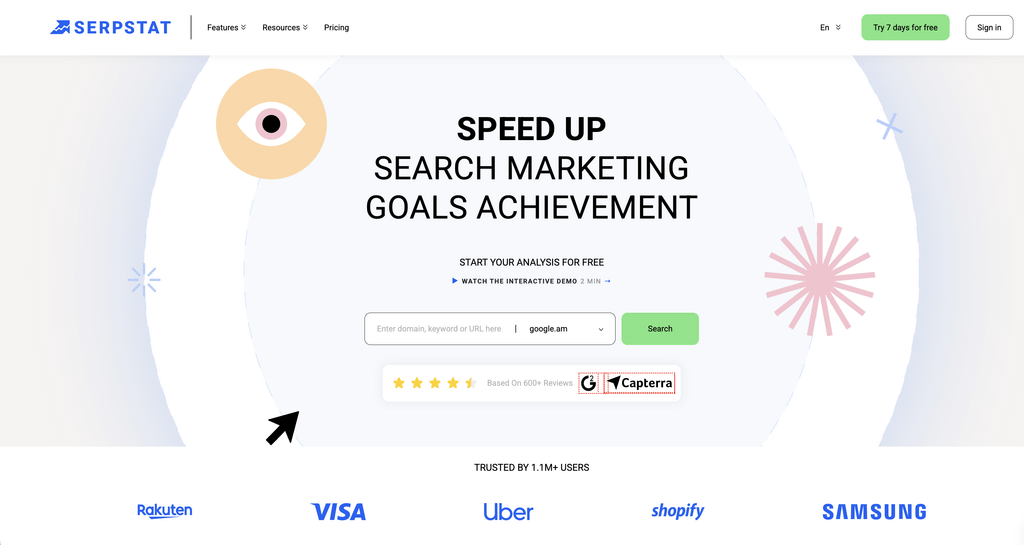
Serpstat is the affordable, full-featured SEO tool. With Domain Analysis you can view a competitor’s estimated organic traffic, keywords and top pages. You can also compare domains side by side.
Individual plan is $50/month, Team is $100 and Agency is $410. No free plan, but the 7-day trial is $1.
Best for: a full SEO tool on a budget, especially if your competitors are in Europe.
Pros:
- One of the cheapest full SEO tools at $50 a month
- Known for good coverage of European search results
- $1 trial to test it properly
Cons:
- Backlink data is thinner than Ahrefs
- The interface feels older than the bigger tools
6. Ubersuggest
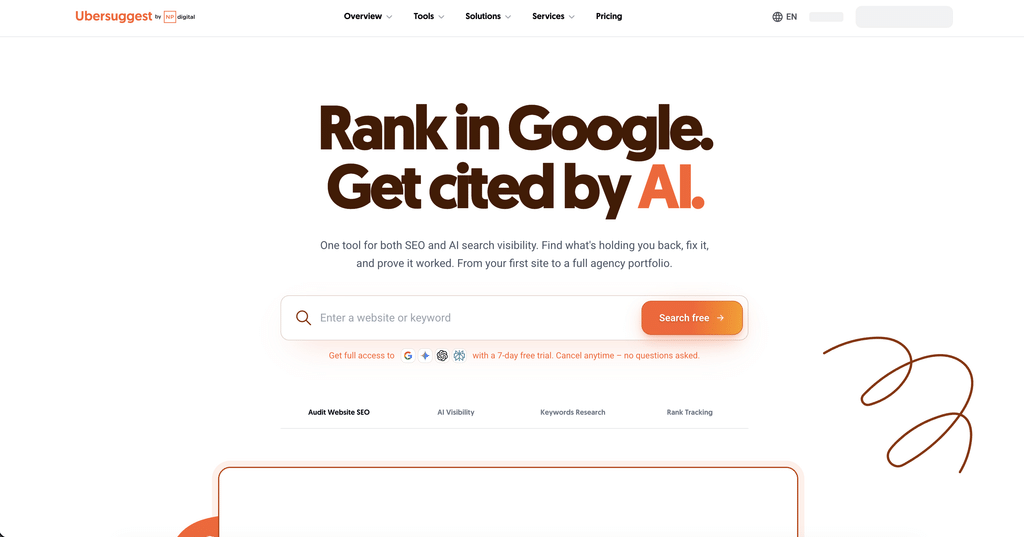
Ubersuggest is the easiest to learn here. Just type a domain into Traffic Overview and you’ll get estimated organic traffic, top pages and the keywords behind them – no SEO-speak.
Plans are $29, $49 or $99 a month, and if you hate subscriptions, it sells lifetime plans starting at $290.
Best for: beginners who want simple numbers.
Pros:
- The simplest interface of the group
- Lifetime plans, so no monthly bill
- In the test above, it came closest on one of the two sites
Cons:
- Thinner data than the bigger tools
- The free version only gives you about 3 searches a day
What to avoid
SEO group buy tools. You will see people suggesting shared accounts for Ahrefs or Semrush at a fraction of the cost. They violate the tools’ terms, can be shut down with no warning, and you’re logging into an account that someone else controls. Not worth it for your business.
Lists with Google Analytics, Clicky, Mixpanel or Quantcast. Some lists include these but they only measure your own site. They can’t show you traffic from a competitor.
Moz and Mangools for traffic. Both are good for keyword research and Domain Authority checks, but neither will give you a competitor’s traffic estimate so they are not real replacements here.
Which one should you pick?
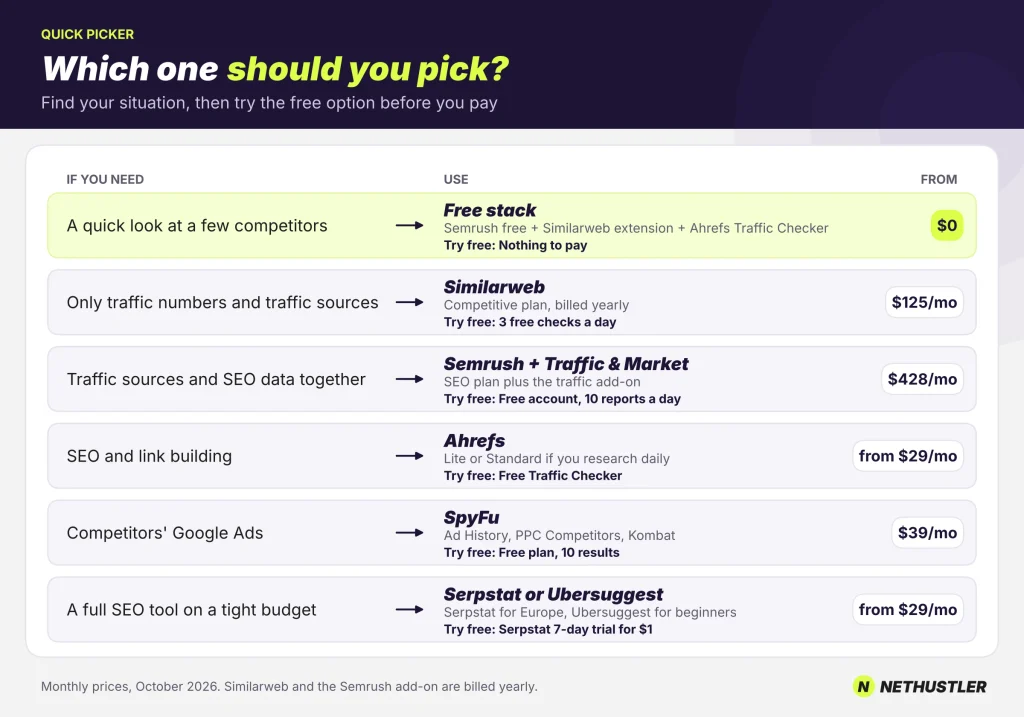
| Your situation | What I’d use |
|---|---|
| Small blog or side hustle, checking a few competitors | Free stack: Semrush free + Similarweb extension + Ahrefs Traffic Checker |
| You only need traffic and traffic sources | Similarweb’s entry plan |
| You need traffic sources and SEO data | Semrush with Traffic & Market |
| SEO and link building | Ahrefs |
| Running Google Ads | SpyFu |
| Tight budget, still want a full tool | Serpstat or Ubersuggest |
FAQ
What is the best alternative to Similarweb?
Semrush, for most people. With the Traffic & Market add-on, it’s the only other tool that estimates total traffic and where that traffic comes from. If your main focus is on SEO and backlinks, then Ahrefs is the better option.
What is the best free alternative to Similarweb?
A free Semrush account (10 reports per day). If you want a quick look at a single site’s organic traffic, Ahrefs’ free Traffic Checker is faster.
Is Similarweb free?
Partly. The website allows 3 free checks a day and there is a free Chrome extension as well. The free account bumps that up to 15 analyzes a day with 1-3 months of data. Paid plans start at $125/month, billed annually. Full details are in my Similarweb pricing guide.
Is Semrush better than Similarweb?
For SEO, yes: it has way more keyword and backlink data. If that’s all you need, Similarweb goes deeper for traffic sources and audience data, and it’s cheaper.
Does Ahrefs show total website traffic?
No. Ahrefs only estimates traffic coming from Google search. To see direct, social, referral, and paid traffic you need Similarweb or Semrush’s Traffic & Market add-on.
Which tool is most accurate for website traffic?
None of them. Ever. In the above tests a different tool came closest each time. One tool for all your competitors and focus on trends.
Can Google Analytics replace Similarweb?
Only for your site. Google Analytics and Search Console show real traffic but not from a competitor.
Final thoughts
You likely don’t need to shell out $200 a month to see a competitor’s traffic. Begin with the free stack and the spreadsheet above. If you hit the limits every week, pay for the tool that matches what you actually do: Ahrefs for SEO, SpyFu for ads, or If traffic sources, all you need is Similarweb.
Still deciding on Similarweb? Read how Similarweb works and what it costs.
Stay hustlin’ and choose the best tools!