How to Make Money on Etsy in 2027 (Real Fees, Costs and Earnings)


The bottom line for making money on Etsy in 2027 is three things: a product that can maintain a healthy margin after fees, a price above $25 where you can get it, and some traffic of your own. Etsy’s core fees are around 9.5% of each order plus $0.45 for a US seller, and Offsite Ads can take another 15%. Physical products typically keep 29% to 54% of the order after materials and shipping.
That’s the tidy version. Here’s what that looks like in practice.
Your first Etsy sale is epic for about 10 minutes. A stranger just paid $35.50 for a candle you made in your kitchen. Tell your partner, call your parents and start checking flights to the Maldives.
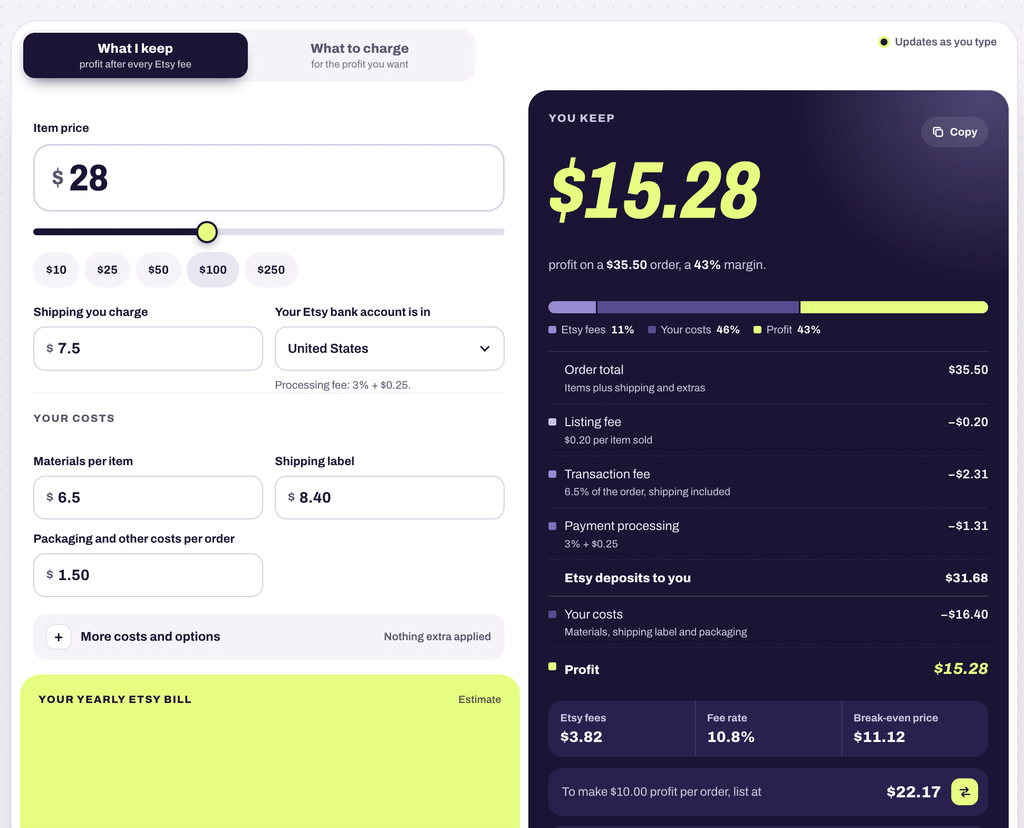
Then there is the payout. Etsy retained $3.82. The shipping label cost $8.40 The wax, wick and jar cost $6.50. The box cost another $1.50. You’ve got $15.28 and nobody’s paid you for the hour it took.
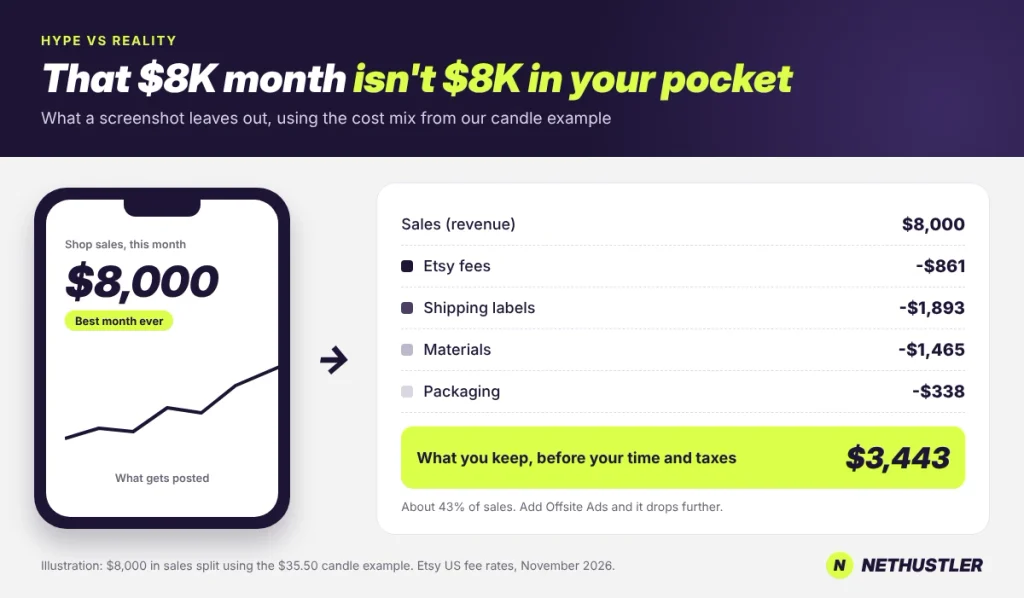
That’s not a horror story, by the way. That’s a pretty good 43% margin. But that’s a far cry from the “$8K month” screenshots, and it includes a number you won’t find in any of them: Etsy sellers averaged about $1,870 in sales in 2025. The whole year.
So here is the deal. Etsy is a marketplace where you can sell handmade goods, vintage items, craft supplies or digital downloads and then take home whatever is left after fees and costs. This guide is all about the “what’s left” part: six real products broken down to the cent, plus how many orders it takes to hit $500, $1,000 or $2,000 a month.
What You Actually Still Have on Etsy in 2027.
- Etsy charges a core fee of about 9.5% of each order plus $0.45 for a US seller. that’s accounting for the 6.5% transaction fee, the 3% + $0.25 payment processing, and the $0.20 listing fee.
- The cheaper the item, the more you lose. A $5 sale loses about 18.5% in fees, but a $100 sale loses only about 10%.
- Offsite Ads can add an extra 15% (12% once your shop reaches $10,000 in yearly sales). Total fees come in around 25% to 33% on those orders.
- For physical products in this guide, after materials, shipping and packaging, 29% to 54% of the order is left. Digital products make up 70% to 85%.
- Etsy’s own filings estimate average sales per active seller at about $1,870 in 2025. That’s before fees and costs and the typical shop probably makes less.
Or skip the reading and plug your own product into our free Etsy fee calculator. It covers 19 countries and gives you your break-even price and your yearly Etsy bill.
Pick your starting point:
- No shop yet. Read the 6 profit examples and the business model comparison and follow the 8 steps. You’ll know which products are worth making before you spend a dime on materials.
- Selling now but payouts appear small. Skip the candle breakdown, the Offsite Ads section and the time math. Usually, the missing money is hidden in one of these.
- Sale from outside the U.S. Begin with the Non-US fee section. You pay more per order than most guides will tell you, so your prices have to reflect that.
Every Etsy fee in 2027 (and which ones you can’t avoid)
Etsy charges three fees on almost every sale: a $0.20 listing fee, a 6.5% transaction fee and a payment processing fee. You can’t dodge those. Everything else depends on where you live and which extras you switch on.
| Fee | Rate (US sellers) | Mandatory? | Charged on |
|---|---|---|---|
| Shop set-up fee | One-time, varies by location (sellers report $15 to $29) | Yes, for new shops | Opening the shop |
| Listing fee | $0.20 per listing, renews every 4 months | Yes | Each listing, and each renewal after a sale |
| Transaction fee | 6.5% | Yes | Item price + shipping + gift wrap + paid personalization |
| Payment processing | 3% + $0.25 | Yes | Full order total, including sales tax |
| Offsite Ads | 15%, or 12% after $10,000 in 365-day sales, capped at $100 per order | Optional under $10,000, required after | Orders from Etsy’s ads on Google, Pinterest and other sites |
| Etsy Ads | You set a daily budget | Optional | Clicks on your promoted listings inside Etsy |
| Regulatory operating fee | 0% in the US, 0.05% to 1.97% in nine other countries | Yes, where it applies | Item price + shipping |
| Currency conversion | 2.5% | Only if listing currency differs from your bank’s | Converted sales |
| Etsy Plus | $10 per month | Optional | Subscription (includes 15 listing credits + $5 ad credit) |
| Pattern | $15 per month after a 30-day trial | Optional | Your own Etsy-powered website |
| Shipping labels | Carrier rate | Only if you buy labels on Etsy | Each label |
The listing, transaction, Offsite Ads, Etsy Plus and Pattern rates come straight from Etsy’s Fees & Payments Policy, last updated October 5, 2026. Processing rates come from the Etsy Payments Policy.
The simple Etsy fee formula
For a US seller with no ads, the fee on any order is:
Etsy fees = 9.5% × (item price + shipping) + $0.45That’s 6.5% + 3% = 9.5% of the order, plus $0.25 processing and $0.20 listing. Add 0.15 times the order total if the sale came from an Offsite Ad.
Three fee gotchas that catch new sellers
- Etsy also takes a cut for shipping. 9.5% on $7.50 if you charge $7.50 for shipping. Charging shipping inside a “free shipping” price does not change the price. Either way, Etsy gets paid.
- If a listing has multiple quantities, it renews each time it sells. If you sell 10 units on one listing, you pay $0.20 ten times, not once.
- Offsite Ads become permanent at $10,000. Once your shop crosses $10,000 in any 365-day period, Etsy’s Offsite Ads rules say you can’t opt out for the lifetime of your shop, even if sales drop later.
If you sell from outside the US
Bad news if you’re not in the US: you usually pay more per sale. Processing is often 4% instead of 3%, nine countries add a regulatory operating fee, and many charge VAT or GST on top of Etsy’s fees.
| Seller country | Processing fee | Regulatory operating fee (from June 22, 2026) |
|---|---|---|
| United States | 3% + $0.25 | None |
| United Kingdom | 4% + £0.20 | 0.48% |
| France | 4% + €0.30 | 1.14% |
| Italy | 4% + €0.30 | 0.80% |
| Spain | 4% + €0.30 | 0.88% |
| Hungary | 4% + €0.30 | 1.97% (new) |
| Germany, Netherlands, Ireland | 4% + €0.30 | None |
| Canada | 3% + CA$0.25 domestic and US, 4% + CA$0.25 international | 0.50% |
| Australia | 3% + A$0.25 domestic, 4% + A$0.25 international | None |
A UK seller pays about £3.11 in Etsy fees for a £25 item, plus 20% VAT on the fees. So about £3.73 (14.9%) in total. A US seller with an item priced at $25 pays $2.83, or 11.3%. Same product. Same price. The UK retailer just stocks less.
Outside the US and EU, it gets rougher
I’m based in Armenia, so I looked up my own country first. As of November 2026, it isn’t on Etsy’s list of countries eligible for Etsy Payments at all. Next door in Georgia, sellers can get in, but only through a Payoneer account, and the terms are a lot worse than the table above.
In the Payoneer countries (Georgia, Kazakhstan, Serbia, Egypt, Pakistan and several in Latin America), Etsy’s processing fee is 6.5% + $0.30 instead of 3% + $0.25. On a $25 order that’s $3.75 in Etsy fees, or 15%, against $2.83 for a US seller. Etsy pays you in US dollars into Payoneer, the set up fee is charged in USD and Payoneer can charge a withdrawal fee of up to 3% when you move the money to your bank.
If you sell from one of these countries, you should add in fees of at least 15%, not the 9.5% that US guides quote.
The June 2026 rates are listed in the table of changes below. If you sell outside the US, our calculator works out Etsy fees for 19 countries, including the regulatory fee and tax on fees.
What changed in 2026, and what’s coming in early 2027
| Date | Change | Who it affects |
|---|---|---|
| Jan 20, 2027 | Shipment-level customs data required for parcels to US buyers worth $2,500 or less | Non-US sellers shipping to the US |
| Jan 4, 2027 | Share & Save refund drops from the full 6.5% back to the usual 4% (how Share & Save works) | Enrolled sellers |
| Oct 20, 2026 | Share & Save refunds the full 6.5% transaction fee on orders from your own links | Enrolled sellers |
| Jul 30, 2026 | Paid personalization ($0.20 to $500), which carries the 6.5% fee | Personalized product sellers |
| Jul 9, 2026 | Duties must be prepaid (DDP) on US orders, or Purchase Protection is lost | Non-US sellers shipping to the US |
| Jul 1, 2026 | EU €3 customs fee per item on imports under €150 | Sellers shipping into the EU from outside |
| Jun 22, 2026 | Regulatory operating fee changes in 7 countries | UK, France, Italy, Spain, Hungary, India, Türkiye sellers |
| May 7, 2026 | Purchase Protection pays up to $250 per case and requires replies within 48 hours | All sellers |
Do this today: open Shop Manager, go to Settings, then Offsite Ads, and check whether you’re enrolled. Every shop is by default.
What you actually keep: 6 real Etsy profit examples
Okay, enough of the fee tables. This is what’s left on six common products after Etsy and your costs. A US seller gets to keep anywhere from 29% to 85% of every order, and an Offsite Ad sale will eat up about a third of that.
| Product | Order total | Etsy fees | Your costs | Profit | Margin | Profit if from an Offsite Ad |
|---|---|---|---|---|---|---|
| Digital planner (PDF) | $8.00 | $1.21 | $0.00 | $6.79 | 84.9% | $5.59 |
| Sticker sheet, free shipping | $6.00 | $1.02 | $2.30 | $2.68 | 44.7% | $1.78 |
| Soy candle, $28 + $7.50 shipping | $35.50 | $3.82 | $16.40 | $15.28 | 43.0% | $9.95 |
| Print-on-demand t-shirt | $29.99 | $3.30 | $18.00 | $8.69 | 29.0% | $4.19 |
| Personalized necklace, free shipping | $45.00 | $4.73 | $16.00 | $24.27 | 53.9% | $17.52 |
| Vintage lamp, $120 + $12 shipping | $132.00 | $12.99 | $49.00 | $70.01 | 53.0% | $50.21 |
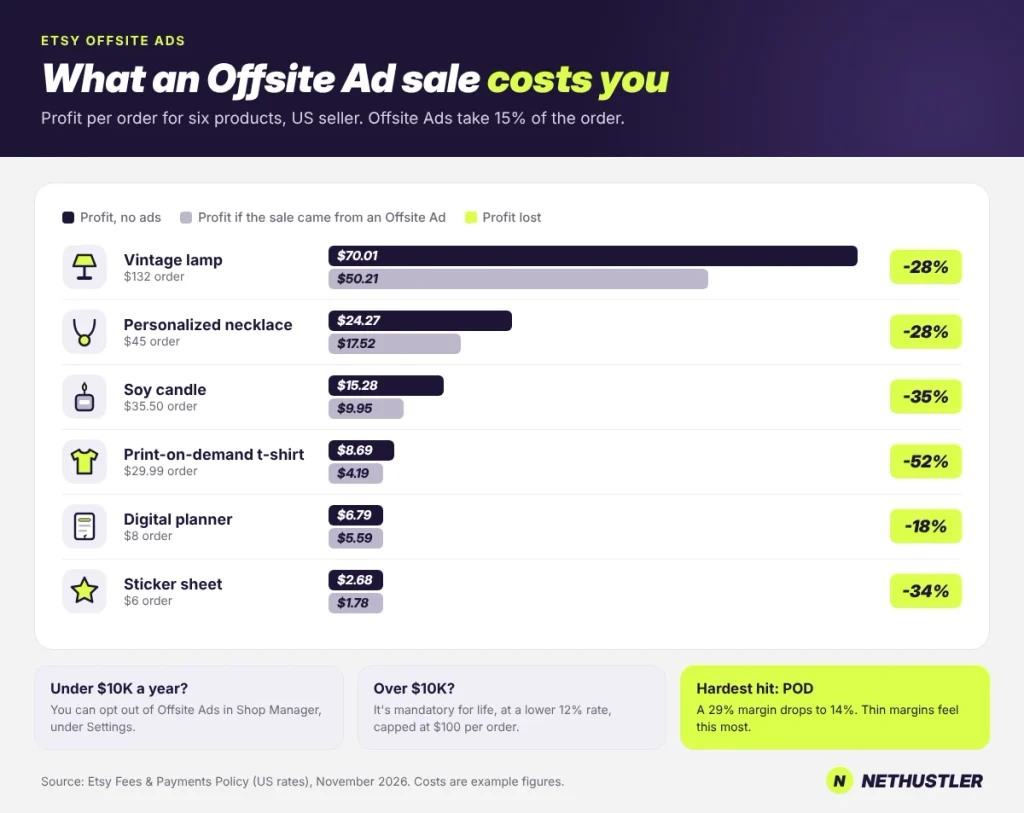
Cost assumptions: $1.20 in materials, $0.80 stamp and envelope, $0.30 packaging. Candle $6.50 wax, wick, jar and fragrance $8.40 label $1.50 packaging. POD tee $18.00 production plus shipping from the print partner. Necklace: Materials $9, label $5, packaging $2 Old lamp. $35 cost to source. $12 label. $2 packaging. Swap them in as your costs will be different.
Just a quick word before you compare these to your own products. Here, “profit” means what you have left after you pay your income taxes and your time taxes. The packing and the shipping label is already out. Materials, Your hours, your camera. The test batches that went in the bin aren’t. For the same reason, the digital planner is also $0 in cost, the hours it took to design it are not counted.
If your numbers are way off, look at shipping first. Labels for heavy or bulky items get expensive fast. Then view materials. After you sell steadily, buying in small amounts is more expensive per unit than buying in bulk..
One order, line by line: the $28 soy candle
Here’s every deduction on one candle order:
| Line | Amount |
|---|---|
| Buyer pays (item $28.00 + shipping $7.50) | $35.50 |
| Transaction fee (6.5% of $35.50) | −$2.31 |
| Payment processing (3% of $35.50 + $0.25) | −$1.31 |
| Listing renewal | −$0.20 |
| Wax, wick, jar, fragrance | −$6.50 |
| Shipping label | −$8.40 |
| Box, filler, thank-you card | −$1.50 |
| Profit before your time and taxes | $15.28 (43%) |
Now, imagine that same buyer found you via an Offsite Ad on Google. Etsy takes another 15% ($5.33) and your profit now is $9.95. Same candle, same buyer, 1/3 the money.
One more thing: payment processing is charged on the sales tax your buyer pays, although Etsy collects that tax and remits it for you. That’s about $0.07 more for this order with a 7% sales tax rate. Sure, pennies. But now you see why your fee statement never comes out to a clean 9.5%.
What sellers on Reddit and the Etsy forums actually report
I checked recent Offsite Ads threads on r/EtsySellers to see how frequently the fee actually appears. Answer: It’s all over the place. A seller who makes his living running ad campaigns says most shops he knows get 2% to 4% of sales from Offsite Ads. Another had $1,800 in monthly revenue and $15 in Offsite Ads fees, so only about $100 of those sales carried the fee. At the other end, a seller who has used it for four years says one in three sales is generated by the ads. Etsy estimated one in ten at launch.
The angry posts follow a pattern too. First sale for new shop: $97.99 order, $14.70 Offsite Ads, $5.45 profit. A print-on-demand hoodie cost $58 CAD to make and sold for $74.99 CAD. A $4.33 loss, or $7.48 profit without the fee. Both threads of responses said the same thing. The sale wasn’t killed by the ad fee. It was the thin margin.
The Etsy Community forums fill in the other half: what happens when the ads go away. In a 2020 thread asking whether opting out hurt sales, several small shops said they noticed no difference, and one added that their shop got very few sales from the ads anyway. Bigger shops tell a different story. One seller above the $10,000 mark said about 65% of their sales came from Offsite Ads, and that views and orders dropped hard once the ads stopped showing.
So opting out costs you little if the ads were never doing much, a lot if they were carrying the shop. The Offsite Ads page in Shop Manager tells you which one you are.
The best tip I’ve gotten from those threads is to price for your average, not the worst case. Take 15% times the percentage of your orders that have the fee. If it’s one in three, that’s 5% over all your orders. One in twenty? That’s less than 1% But one catch that caught some sellers off guard: the fee covers anything the buyer orders from you within 30 days of the click, custom orders included.
Why low prices are an Etsy trap
It sounds smart to start cheap to get your first sales. The catch is that Etsy’s fixed charges are the same on a $5 sale as a $500 one ($0.25 processing plus the $0.20 listing renewal). On a $5 sticker they eat 9% of the order before the percentage fees kick in.
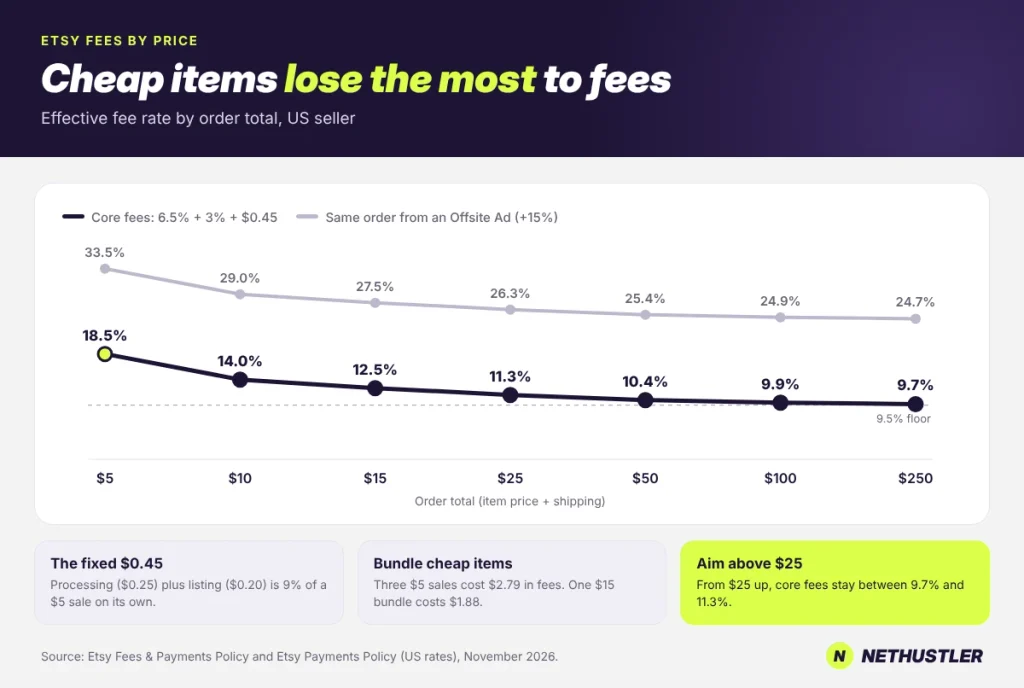
So if your product can command a higher price, shoot for over $25. Core fees from there are 9.7% to 11.3% and most of each additional dollar is yours. You might also have fewer buyers at a higher price. So look at what similar listings actually sell for before you jump. Bundle if it can’t (stickers, bookmarks, small prints). Three $5 sticker sheets sold individually run $2.79 in fees and three envelopes. One envelope and $1.88 in fees for a 3-pack of $15
Five minute job: take your cheapest listing and see what it really makes after fees. Increase the price. Bundle it if it’s less than a couple of bucks. The exact price formula is given in step 4 below.
The costs Etsy doesn’t show you
So if your product can command a higher price, shoot for over $25. They’re in your statement. Startup costs, advertising, refunds, taxes and your own time are not, but they come out of the same sale.
Startup costs: what it takes to open a shop
The good news first: you can launch an Etsy shop for less than $100. This is a first shot at a budget. The inventory, supplies and ad lines are my guesstimates so adjust them for your product.
| Cost | Lean digital shop | Handmade starter | Vintage reseller |
|---|---|---|---|
| Shop set-up fee | $15 to $29 | $15 to $29 | $15 to $29 |
| 20 listings at $0.20 | $4 | $4 | $4 |
| First inventory or materials | $0 | $100 to $300 | $150 to $500 |
| Packaging and shipping supplies | $0 | $30 to $60 | $30 to $60 |
| Design or photo tools | $0 to $15 | $0 to $15 | $0 |
| Etsy Ads test budget (optional) | $30 | $30 | $30 |
| Typical total | $50 to $80 | $180 to $440 | $230 to $625 |
The set-up fee is set by Etsy per location and shown during onboarding. Etsy’s help center only says the cost varies by location, and sellers have reported amounts between $15 and $29.
Etsy Ads and Offsite Ads
Etsy has two ad programs, and they charge you in two completely different ways. One you command. The other one is on by default for every shop. You could end up paying for it without ever opting in.
- Etsy Ads run right in Etsy search. You pay for each click and set a daily budget. You can turn them off at any time.
- Offsite ads on Google, Pinterest, Facebook and other sites. You don’t pay per clicks. You pay 15% of the order when a buyer clicks an ad and makes a purchase within 30 days (12% for annual sales over $10,000, with a $100 per order cap).
For shops under $10,000 per year, you can opt-out of Offsite Ads in Shop Manager under Settings. But first go there on the Offsite Ads page and see what orders it has generated and how much you have paid for them. And then be honest about whether those buyers would have found you anyway. If they didn’t, a smaller profit on a sale you never would have made is still better than $0.
If your profit per order is thin, I would opt out. The POD tee above is $8.69 and $4.19 in an Offsite Ad sale. Not much of a business. If your margins are good and the shop is new, I would leave it on for a couple of months. It’s a cheap way to get some early sales, you only pay when someone actually buys. Just know you go over $10,000 and the off switch disappears.
Returns, refunds and cases
Etsy refunds the transaction fee when you refund an order (partial refunds are pro-rated). Your materials and shipping label are missing. Keep an eye on your messages, as Etsy’s Purchase Protection (since May 7, 2026) also demands a response to any case within 48 hours.
For physical items, I would set aside a few percent of revenue for refunds and replacements. The cheap way to keep that number down: clear photos from every angle, exact sizes in the description, and an honest processing time. Fewer surprises and fewer refunds.
Your time
Nobody likes this bit but it tells you if the shop is worth your evenings. Divide the profit per order from the above examples by the time each order really takes: making, photographing, listing, packing and responding to messages.
| Product | Profit per order | Time per order (estimate) | Effective hourly rate |
|---|---|---|---|
| Personalized necklace | $24.27 | 40 minutes | $36 per hour |
| Soy candle | $15.28 | 25 minutes | $37 per hour |
| Sticker sheet | $2.68 | 5 minutes | $32 per hour |
| Print-on-demand tee | $8.69 | 5 minutes | $104 per hour |
Looks good on paper, and that POD number looks ridiculous. Time per order is my own rough guess so use the table as a template and put in your real minutes. The larger catch: These rates only count time spent on each order. There’s nothing that pays for designing new products, shooting photos, writing listings, researching tags and sitting through slow weeks and in your first year they can eat more hours than the orders do.
Try it for a month. Start a note on your phone and keep track of every hour you spend in the shop for one month. Boring stuff included. Then divide the hours into the profit for that month. If it’s less than you’d make freelancing for a few hours, you’re better off finding out now rather than after you’ve scaled up.
What Etsy’s own surveys say about time
Etsy has asked its sellers about this. In its 2024 seller report, published in early 2025, sellers said they spend 52% of their business time making or designing, and the rest on admin. So for every hour at the workbench, plan on nearly another hour for everything else.
Now do that to the table. If the candle is 25 minutes and most of that is hands-on, the real number is about 48 minutes with the admin half and $37 an hour is about $19. Still good for a side hustle. It’s not just the number you get from timing the pour.
Taxes on Etsy income
Not the fun part, but skipping gets expensive. Etsy profit is taxable income, tax form or no tax form. Form thresholds only affect what is reported not what you owe. My advice: put aside a set amount of each payout into a separate account, so the tax bill doesn’t fall on money you’ve already spent.
- US sellers: under the One, Big, Beautiful Bill, Etsy only has to send a Form 1099-K if you top $20,000 in payments and 200 transactions in a year, per the IRS. You still report all income below that. If your net self-employment earnings reach $400, self-employment tax (15.3%) applies too.
- Sales tax: Etsy collects and remits sales tax for you in most US states, so you typically don’t deal with it on Etsy orders.
- Sellers in the UK and EU: you’ll typically find that Etsy’s seller fees include VAT and you’ll need to keep an eye on your own income tax and VAT thresholds.
I’m not a tax advisor, so check your local rules or talk to an accountant once your shop starts to make regular sales. “Start keeping your records clean. If you also sell custom orders directly to clients, our free invoice generator will keep those payments documented.
How much do Etsy sellers really make?
I’m not a tax advisor, so check your local rules or talk to an accountant once your shop starts to make regular sales. In 2025, the average Etsy seller made $1,870 in gross sales.
In its 2025 annual report (Form 10-K), Etsy reported $10.46 billion in marketplace gross merchandise sales (GMS) and 5.6 million active sellers. Divide one by the other and you get $1,868 per seller for the year.
And for most sellers the real number is lower. Three reasons:
- GMS is before fees & costs. With the candle example, a 43% margin yields about $800 a year, or $67 a month, on $1,868 in sales.
- Etsy considers any seller with a sale or a charge in the last 12 months as an active seller, so a shop with 2 sales is the same as a full time business.
- A small cluster of high-volume stores lifts the average, meaning the typical (median) store probably makes less than $1,868. Etsy doesn’t publish a median, and no one outside the company knows the exact number.
There are plenty of Etsy income reports out there with nice medians and percentiles. Most are from self-selected surveys, or the users of a tool itself, so I’d take them with a big pinch of salt.
But don’t let that number scare you. The “average” shop is small, part-time and often barely active so it says very little about a shop someone actually works on. Your own profit per order, and the number of orders you can realistically expect to get say a lot more and we’ll get to both in a minute.
Is Etsy still growing in 2026?
Yes, after a rough patch. In its Q3 2026 quarterly report (Form 10-Q), Etsy reported marketplace GMS up 8.8% year over year to $2.65 billion, with active buyers up 1% to 87.5 million. Its Q3 2026 shareholder letter adds that the active seller base grew at its fastest rate in two years.
Good news, bad news there.
More buyers = More demand coming through search.
More sellers = More stores fighting over same keywords.
Spending per buyer also rose, to $126 a year, and that helps if you sell giftable or higher-priced items.
Etsy also forecasts a take rate of around 25.8% in 2026. That is its total revenue divided by GMS, so it includes ads and services as well as the fees on your orders. Ad revenue was one of the factors behind its growth in Q3. Etsy profits more when sellers spend more on advertising. That doesn’t mean ads are a bad deal. That just means you do your own math before budgeting.
How many sales do you need to hit your income goal?
Now the fun part. Here’s how many orders each product needs to hit an income goal, using the profit per order from our six examples (no Offsite Ads):
| Product | Profit per order | Orders for $500/month | Orders for $1,000/month | Orders for $2,000/month |
|---|---|---|---|---|
| Sticker sheet | $2.68 | 187 | 373 | 746 |
| Digital planner | $6.79 | 74 | 147 | 295 |
| Print-on-demand tee | $8.69 | 58 | 115 | 230 |
| Soy candle | $15.28 | 33 | 65 | 131 |
| Personalized necklace | $24.27 | 21 | 41 | 82 |
| Vintage lamp | $70.01 | 7 | 14 | 29 |
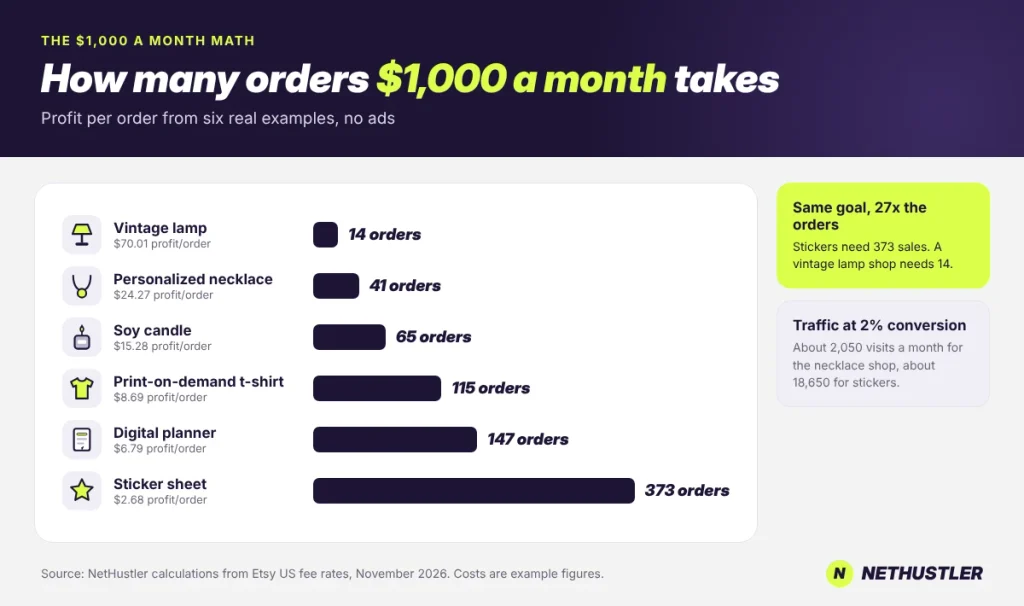
Those orders come from store visits. You can view your actual rate in Shop Manager, under Stats. If 2% of people who visit buy, it takes about 2,050 visits to make $1,000 a month in profit for the necklace shop, and about 18,650 for the sticker shop. Same traffic, about 9 times the income.
So after your first month, open Stats in Shop Manager and write down your visits and conversion rate. If your visits are a fraction of what your product needs, you have two choices. make more per order (price, bundles, personalization) or bring the traffic yourself with social posts, Pinterest or ads. The slow option is to wait for Etsy search to fix it.
How to make money on Etsy: 8 steps that protect your profit
If you want to make money on Etsy, pick a product with a nice margin after fees (my rule of thumb is 40% or more), price it with a formula, optimize listings for Etsy search, and track profit per order every month. If I ever opened a shop today, this is how I’d start.
1. Run the numbers before you make anything
Before you buy materials or design a single file, check your Etsy profit and break-even price with your expected price and costs. If you can’t get a 40% margin with Offsite Ads on, close the tab and pick another product. No room left for refunds or a slow month.
2. Check demand inside Etsy
Search for your product idea on Etsy and look through the first two pages. Pay attention to the price range, how many recent reviews the top shops have, and which listings have a Bestseller badge. Good sign people are buying recent reviews on similar items. Etsy’s search autocomplete also shows what real buyers type.
Reddit is another free source, since people there ask for gift ideas and product recommendations in their own words. Our guide shows how to find product and keyword ideas on Reddit.
3. Set up the shop the cheap way
Set up Etsy Payments and Write Clear Shop Policies (Returns, Processing Time, Custom Orders) Pay the set up fee. Make sure your listing currency matches your bank account currency or Etsy charges you 2.5% on every converted sale.
4. Price with a formula, not a feeling
This formula gives you the price that hits a target profit:
Etsy fees = 9.5% × (item price + shipping) + $0.45
Price = (your costs + target profit + $0.45) ÷ (1 − 0.095 − ad buffer)
If you have opted out of Offsite Ads, set the ad buffer to 0. If you want every sale to be protected, set it to 0.15.
For example, you have a necklace you are giving away for free that costs you $16 to make, pack and ship and you want to make $20 profit on each sale. Without ad buffer, price is ($16 + $20 + $0.45) / 0.905 = $40.28. With the full Offsite Ads buffer it’s ÷ 0.755 = $48.28. Round to $40 or $48, depending on your ad settings..
5. Build listings Etsy search can understand
- Title: Make it readable, and put the main phrase a buyer would search for first. A human readable title is better than a bunch of keywords.
- Tags: use all 13, use multi word phrases like “personalized dog mom gift” not single words.
- Attributes and variations: Fill in all relevant attributes. Physical listings can now use three variation types, up from two.
- Photos and video: Complete all photo slots and include a video. Listings can feature two videos now.
- Customization: If you tailor it, charge for it. From July 30, 2026, you can assign a price of $0.20-$500 to personalization fields.
6. Get your first 10 sales and reviews
A new shop has zero reviews, so the first sales are the slowest. Bring in some traffic yourself: share listings on Pinterest, Instagram, TikTok or with your network. Enroll in Etsy’s Share & Save program so sales from your own links earn a fee refund. Through January 4, 2027, Etsy refunds the full 6.5% transaction fee on those orders.
If you’re testing Etsy Ads, begin with a small daily budget on your top two or three listings and monitor cost per sale, not clicks. Clicks feel like progress, but the only thing that matters is whether your ad spend per order is less than your profit per order. If you pay $6 and get a candle order that makes $15.28, ads are working. If you spend $9 to sell a t-shirt that generates $8.69, you are paying to be busy.
7. Track four numbers every month
- Profit per order (after fees, materials, shipping and ads)
- Conversion rate (orders ÷ visits, in Shop Manager under Stats)
- Ad spend per sale for Etsy Ads, and your Offsite Ads fees
- Hours spent on the shop
If a listing sells but doesn’t make money after all costs have been paid, you should either raise the price or drop it. I know, it’s tempting to keep a book that is a bestseller but you barely break even on because it gets you reviews. But every hour you spend on it is an hour you’re not spending on products that pay. If you increase a price by 10% for a month, see if buyers even notice.
8. Scale what works, then spread out
Once a product sells steadily, raise its price in small steps and try bundles. After that, look at selling outside Etsy too:
- eBay: works for many of the same products. Our eBay fee calculator shows how its fees compare.
- Amazon: has its own costs and programs, covered in our guide to Amazon side hustles with real costs and earnings.
- Your own site: you pay card fees instead of marketplace fees.
What to sell on Etsy: 5 business models compared
Despite what TikTok might tell you, there is no one “best thing to sell on Etsy.” The best paying model depends on whether you have more time or money to put in. Digital products have the highest margins, vintage the highest profit per order. Print-on-demand takes the least amount of time per sale, but keeps the least of your money.
The easiest way to choose is to start with what you already have:
| If you have… | Start with | Why |
|---|---|---|
| Design skills, but little cash | Digital downloads | Almost no cost per sale, and our planner example keeps 85% |
| A good eye and time to thrift | Vintage | Highest profit per order: $70.01 on our lamp example |
| A craft you already make well | Handmade (jewelry, candles, decor) | 43% to 54% margins, as long as you price for your time |
| Design ideas, but no time to make or ship | Print-on-demand | Fastest to test, but only a 29% margin before ads |
| Model | Margin after fees (our examples) | Upfront cost | Time per order | Best for |
|---|---|---|---|---|
| Digital downloads (planners, templates, printables) | 70% to 85% | Very low | Near zero after creation | Designers who can build once and sell many times |
| Vintage (items 20+ years old) | About 53% | Medium (sourcing) | Medium | Thrifters with a good eye and storage space |
| Handmade jewelry and personalized gifts | About 54% | Low to medium | High | Makers who can charge for customization |
| Handmade home goods (candles, decor) | About 43% | Medium | Medium to high | Makers with repeatable products |
| Print-on-demand (shirts, mugs, posters) | 14% to 29% | Very low | Low | Designers testing ideas fast, at higher volume |
Rules to know before you pick
Etsy only allows things you made, designed or selected yourself: handmade goods, vintage items that are at least 20 years old, craft supplies and digital products you’ve created. You cannot sell mass produced items that you have not designed.
A few 2026 rules matter for specific models:
- AI and production partners: Etsy has improved how sellers define their process, including disclosing AI use and any production partners (like a print-on-demand company).
- Digital sellers: Etsy is experimenting with selling physical prints of sellers’ digital files. If you’re in the US or Canada, eligible shops are added by default unless you’ve opted out, check your settings.
- Sellers shipping internationally: The EU €3 customs fee (effective July 1, 2026) and US prepaid duty rules for non-US sellers (effective July 9, 2026) will change your landed price if you sell internationally. Build them into the shipping or pricing.
Which one would I start with?
I would start with either digital products or vintage, with very little cash and a day job. In theory they give you the best return for your hours. But they’re not free wins. Digital is crowded and cheap, so you need volume (147 planner sales for $1,000 a month). Vintage is a function of what you are able to find and you can’t remake a lamp once it is sold. Handmade can make more per order, but only if you price for your time. Print-on-demand is quick to launch, but its margins of 29% drop to 14% on Offsite Ad orders, not much left over. If you already have a blog or an audience, selling print-on-demand merch from your own site avoids Etsy’s fees altogether.
Is Etsy worth it in 2027?
Yes, if you let the numbers do the talking, not the screen shots. Fees are predictable at about 9.5% + $0.45 per order, plus up to another 15% for Offsite Ad sales. Then it boils down to two things, what you earn per order, and how much traffic you get. Do the first one right first, then the second.
Before you list anything, run your product through our Etsy seller fee calculator and check your break-even price and what you’ll keep. For the rest of the set, browse our free calculators for online sellers and freelancers.
Stay hustlin’, and run the numbers first!
Etsy fees and earnings: FAQ
How much does Etsy take from a $100 sale?
So for a $100 order with no ads, Etsy takes $9.95 for a US seller. $6.50 transaction fee, $3.25 payment processing and a $0.20 listing fee. Add $15.00 if the sale originated from an Offsite Ad. Total $24.95.
Is it free to sell on Etsy?
Nope. New stores pay a one-time set-up fee that varies by location (sellers report $15 to $29), then $0.20 a listing and fees on each sale. No monthly subscription is required.
Can you make $1,000 a month on Etsy?
Yes but the number of orders is very dependent on profit per order. For example, to make $1,000 a month in profit, you need about 41 personalized necklace orders, 65 candle orders, or 373 sticker orders. Much less traffic needed for more expensive products.
Can I avoid Etsy’s Offsite Ads fee?
Yes, as long as you haven’t made $10,000 or more in your store in any 365 day period. You can opt out in Shop Manager, under Settings, then Offsite Ads. Once you are over $10,000 you have to participate for the life of the shop, at the lower rate of 12%.