Affiliate Marketing vs CPA Marketing: Which Is Better?


Ever tried to get paid just for convincing someone to type their zip code into a box?
Yeah, sounds kinda weird. But that’s basically the internet money game in a nutshell sometimes. People ask all the time: what’s the deal with affiliate marketing vs CPA marketing? Is one better? Which one makes more money? Blah blah blah.
Honestly, it drives me a bit crazy, because they’re not really enemies. They’re more like… cousins. One is just a little more high-strung and picky.
Here’s the short answer. Affiliate marketing usually pays you a commission when someone buys. CPA marketing pays you when someone takes a smaller action, like signing up or requesting a quote. CPA is technically a type of affiliate marketing, but people use the two names to mean those two different payout styles.
In this guide, I’ll walk you through how each one pays, when the money actually shows up, the rules that get beginners banned, and which one I’d pick if I were starting today.
What’s the difference between CPA and affiliate marketing?
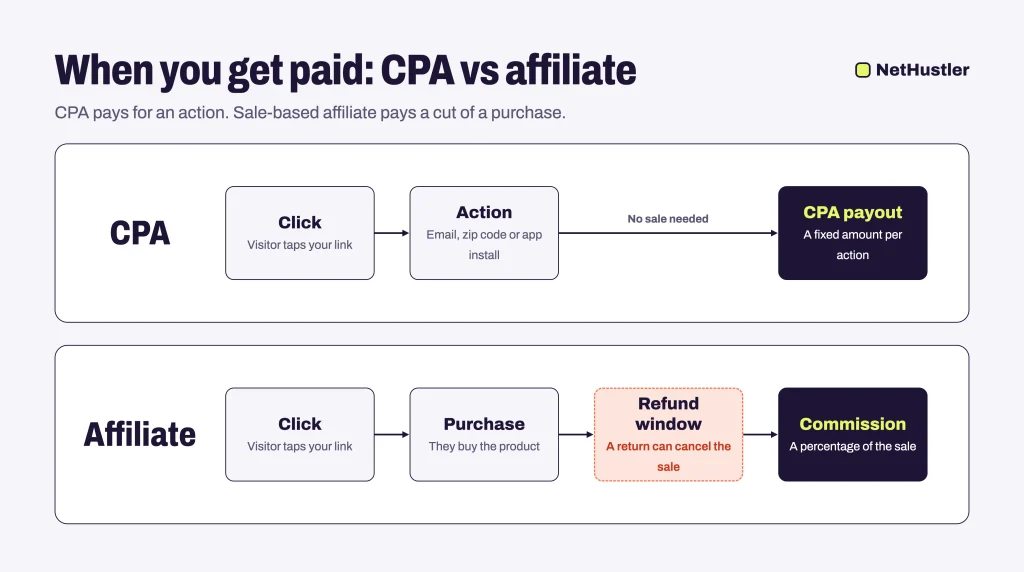
Think of it like this. With regular affiliate marketing, you’re a commissioned salesperson for the internet. You recommend a product, someone buys it through your link, and you get a cut of the sale.
With CPA (cost per action), you get paid when the visitor completes a specific action the advertiser wants. That’s the simple answer to what is CPA in affiliate marketing.
See the difference? You don’t need a sale. You just need the action. This is why people get so hyped about it. It feels easier.
What counts as an “action”?
It depends on the offer, but common ones are:
- Submitting an email address
- Entering a zip code
- Requesting an insurance or service quote
- Starting a free trial of a product or service
- Installing an app on their phone
Some email offers are single opt-in, which means the email submission is enough. Others are double opt-in, so the person also has to confirm by clicking a link in their inbox. Double opt-in offers often pay more because the lead tends to be better quality. When the action is a lead form, you’ll also hear this called pay per lead.
Where “traditional” affiliate marketing fits
Traditional affiliate marketing usually means pay per sale, also written as CPS (cost per sale). You earn a percentage of what the customer spends. Some programs, often software and subscriptions, pay recurring commissions for as long as the customer stays, which is called revshare. It’s just lingo. Don’t overthink it.
Amazon Associates, ClickBank, Awin and CJ are all examples of this model. Rates vary a lot from program to program. The official Amazon commission rates, for example, range from 0% to 10% depending on the category.
CPA vs affiliate marketing at a glance
If you just want the quick comparison, here it is:
| Feature | CPA marketing | Affiliate marketing |
| You get paid for | A lead, signup or install | A completed purchase |
| Payout type | Fixed amount per action | Percentage of the sale |
| Payout size | Smaller | Bigger |
| How easy to convert | Easier | Harder |
| Getting approved | Stricter, often manual review | Usually easier |
| Traffic rules | Strict, set per offer | Usually looser |
| Payment speed | Often faster | Slower, refund windows apply |
| Best for | Targeted traffic you can test fast | Content, SEO and loyal audiences |
Rates and rules vary a lot by program, so always check the current terms before you promote anything.
Which pays more? Compare earnings per click (EPC), not payouts
This is where most people get it wrong. They look at the payout and think a $50 commission obviously beats a $2 lead.
But bigger payouts don’t always mean more money. What really matters is how much you earn from every click you send. That’s called earnings per click, or EPC. (We cover the math behind each model in more detail in CPA vs CPS.)
It’s a lot easier to get someone to enter their email than it is to get them to buy a $200 product. So the small payout usually converts a lot more often.
Here’s a simple made-up example. Now imagine 1,000 people click your links and you test two different offers:
- Offer 1: Sign up for email.
You get $2 every time someone signs up with their email. It’s free.” And it’s fast. So 100 people do. 100 x $2 = $200. - Offer 2: Product sale.
You receive $50 each time someone buys. But buying takes more trust, so only 3 people do it. 3 x $50 = $150.
Now divide what you earned by the 1,000 clicks. That’s your EPC:
| Offer | Earned from 1,000 clicks | EPC |
| Email signup ($2) | $200 | $0.20 |
| Product sale ($50) | $150 | $0.15 |
See that? The “small” $2 offer actually made you more money. But if 5 people had bought the product, you’d earn $250, and the sale would win. That’s why you test, track your EPC, and stop guessing.
It’s a classic trade-off. Do you want fast nickels or slow dimes?
How and when you actually get paid
This is where the “fast nickels vs slow dimes” thing really shows up. Every program pays on its own schedule, and some make you wait a lot longer than others. Here’s how three popular ones compare:
| Program | Model | When you get paid | Watch out for |
| Amazon Associates | Pay per sale | About 60 days after month-end | Longest wait |
| ClickBank | Pay per sale | Every 1 or 2 weeks | 60-day refunds cancel commissions |
| MaxBounty | CPA | Monthly, then weekly | $100 minimum payout |
So with sale-based programs, the waiting usually comes from refund windows. A sale isn’t really safe until that period passes, so don’t count those commissions as spent money yet.
With CPA, leads are often confirmed faster, so the money usually shows up sooner. But they can still be taken back later, which I’ll get to in a second.
What if you work with an advertiser directly?
Once you’ve been at this a while and your traffic converts well, some advertisers may offer you a direct deal outside a network. That can mean a better payout, but it also means no network handles the paperwork. You usually bill the advertiser yourself and wait for them to pay.
Before you agree, get the payout, payment terms and what counts as a valid lead in writing, even if it’s just an email. Then send a proper invoice each pay period so nothing gets missed. You can make one in a couple of minutes with our free invoice generator online, no sign-up needed.
The risks most comparisons skip
Remember how CPA feels easier? But… and this is a BIG but… CPA networks are intense.
They’re protecting their relationships with advertisers. If an advertiser gets junk leads, the network looks bad. So networks can ban you in a heartbeat and not always tell you why.
They want real people, real intent.
Getting approved and staying approved
Most CPA networks review every application. MaxBounty, for example, says it runs identity and fraud checks and can reject an application for any reason.
So be ready to explain where your traffic comes from. If your plan is “uhh, I was gonna post it on my Facebook?”, expect a no.
It also helps to stay active. For example, MaxBounty marks accounts inactive after six months with no activity and may close them after nine.
Allowed traffic sources and countries
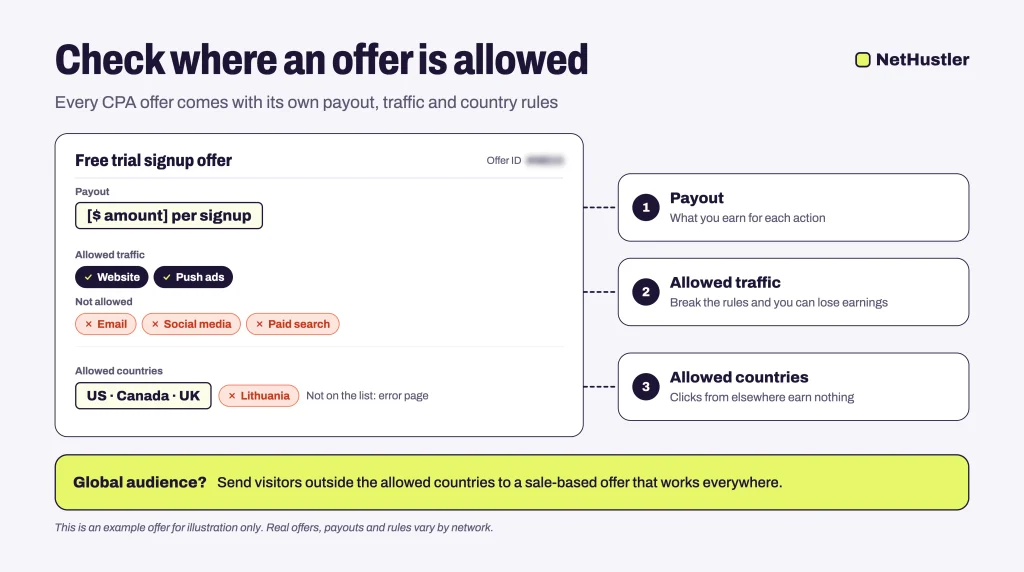
Every CPA offer has its own rules. Some don’t allow email traffic. Some ban social media or paid search. And most are limited to certain countries.
That last one catches many beginners. Say you share a US-only offer in your Instagram bio, and someone in Lithuania clicks it. They’ll likely hit an error page, and you earn nothing.
The fix is simple: check the allowed countries and traffic types before you promote anything. If your audience is global, send visitors outside those countries to a sale-based offer that works everywhere.
Lead reversals
Even after you get paid, a lead can be reversed. MaxBounty’s affiliate marketing FAQ spells this out: conversions that turn out to be duplicates, fraud or invalid data can be taken back, and you have to return that money.
That’s why cheap, low-quality traffic is a trap. It might look great on day one and then disappear from your stats a few weeks later.
Traditional affiliate programs are a little more chill… kinda. Nobody’s watching you that closely, but you can spend $500 on ads and make zero sales.
The risk shifts from pleasing the network (CPA) to managing your own budget (traditional).
Rules that apply to both: disclosure and brand bidding
No matter which model you pick, two rules come up again and again.
FTC affiliate disclosure requirements
In the US, the FTC (Federal Trade Commission) makes sure ads don’t trick people. Its rule for affiliates is simple: if you earn money from a link, tell your readers.
Here’s how to do it right:
- Say it clearly. For example: “I get a commission if you buy through links in this post.” Saying just “affiliate link” isn’t always clear.
- Put it near the link. A note hidden in your footer or on your home page doesn’t count.
- Do it for every type of link. That includes CPA links, not just product links.
Some programs have their own rule too. Amazon, for example, asks you to use this exact line: “As an Amazon Associate I earn from qualifying purchases.”
Bidding on brand names
A lot of beginners think Google will ban them for bidding on a brand name. Actually, the Google trademark policy doesn’t restrict trademarks as keywords.
The rule usually comes from the program itself. Amazon, for example, doesn’t let you bid on terms like “Amazon” or “Kindle” for ads that send people straight to Amazon. Many CPA offers have similar rules, so read the offer terms before you run ads.
The line between CPA and affiliate marketing is blurrier now
These days, the line between the two is getting blurry.
Take ClickBank. Some sellers there pay certain affiliates a fixed amount for the first sale, instead of a percentage. That’s basically CPA, but on a sale. And you keep that money even if the buyer asks for a refund.
You can also mix both on one site. For example, your headphones review links to Amazon, so you earn when someone buys headphones. Another post links to a free trial of a music app and you get paid when someone signs up, even if they never pay.
CPA vs Revenue Share
“Revshare” means you get a small piece every time your customer pays, not just once. It’s common with apps and subscriptions.
Here’s an easy example. Someone signs up for a $10 a month app using your link:
- With CPA, you get paid once for the signup, and that’s it.
- With revshare, you get a small cut every month they keep paying.
So which is better? CPA is better when you want money fast and want to test quickly. Revshare is better when your visitors tend to stick around and you can wait for the money to add up.
Which one should you start with?
Ugh, this question… I get it, you’re new, you want the “easiest” path. There isn’t one. They both take work.
CPA gives you fast feedback, so you learn quickly whether a landing page works. Some CPA networks for beginners do accept newer affiliates, but the rules are strict everywhere.
Sale-based affiliate programs are easier to join, and they reward the skills that last: SEO, writing and building trust. It’s a slower burn, but you’re building something.
Honestly? Stop trying to pick the “perfect” one. They’re just different tools. There’s no right answer, only what’s right for you right now.
My take would be this:
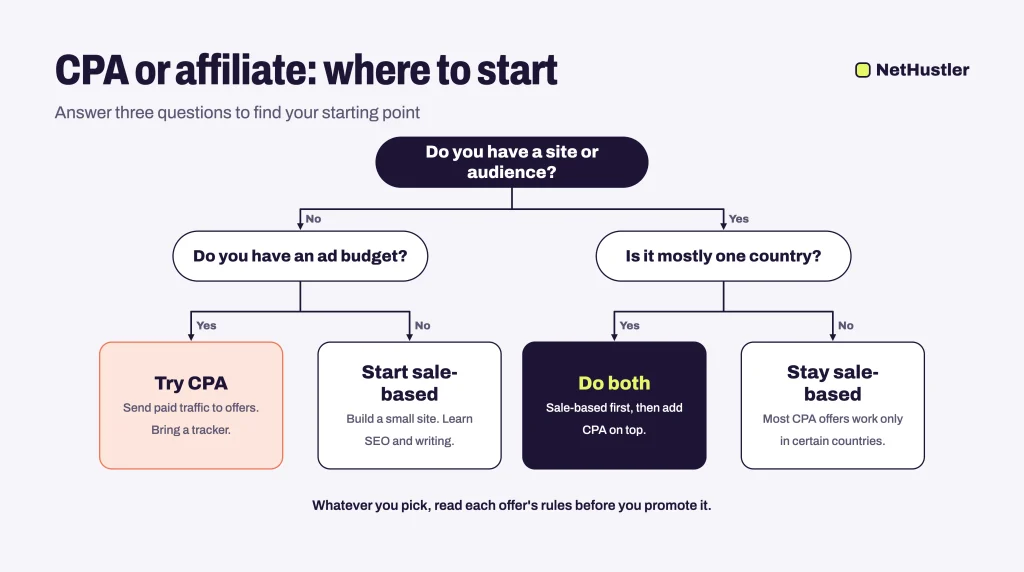
If you’re new, start with sale-based affiliate marketing. Build a small site, learn SEO and writing, and practice sending traffic that actually converts. Once you’ve got a handle on what is affiliate marketing and how does it work, CPA will make a lot more sense.
From there, add CPA on top. It’s a great way to test offers fast and earn from visitors who aren’t ready to buy yet. Just read each offer’s rules before you promote it.
Don’t try to sprint before you can crawl.
Frequently asked questions (FAQ)
Is CPA marketing legit?
Yes. Plenty of legitimate companies pay for leads and signups through CPA networks. Stick to the well-known networks, read the rules of each offer and avoid anyone promising easy money with no traffic.
Is CPA marketing a type of affiliate marketing?
Yes. CPA is one way affiliates get paid. Most people just say “affiliate marketing” for pay per sale and “CPA marketing” for leads and other actions.
What are CPA offers?
They’re deals where an advertiser pays you a fixed amount when someone takes an action, like signing up, entering a zip code or installing an app. You find them inside CPA networks.
Can I do CPA marketing without a website?
Yes, but it’s harder. Some offers allow email or social media traffic, and some affiliates use paid ads instead of a site. Still, networks ask where your traffic comes from when you apply, and ads cost money. A simple website or social profile makes approval a lot easier.
Does CPA marketing pay more than affiliate marketing?
Not always. CPA pays less per conversion but usually converts more often. Compare your earnings per click (EPC) to see which one actually earns more.
Can you get banned from a CPA network?
Yes. Networks can close your account for low-quality or fake traffic, breaking an offer’s rules, or long inactivity. Some won’t tell you exactly why.