
8 Side Hustles for College Students That Fit Around Classes (2026)


Need money in college but your schedule changes every semester and you can’t commit to fixed shifts at a store?
You’re not alone. About two in three college students work while they’re enrolled, and plenty of them are juggling a job that doesn’t care when their exams are. A good side hustle helps with that. You set your own hours, the pay is good, and the best ones teach you skills you can use after you graduate.
It is not a list of 50 ideas. But it’s the eight that a student can actually start with this month, without having to pay for a course or buy inventory first.
I did two of them myself: freelance and translating. And then freelancing grew to 200k+ on Upwork over time, so I’ll go deeper on those. Otherwise I’ve cross-referenced the current pay with the platforms themselves and government data, reading Reddit threads where students have compared what actually worked for them (skipping the endless referral link spam).
The short version:
- Freelancing is the highest ceiling. After graduation, your rate keeps going up.
- Translation is the easiest skill to market if you can speak two languages well.
- Some of the best paying per hour skilled work out there is tutoring high schoolers and there is no setup.
- The least stressful campus jobs are the ones with downtime, so you can study on the clock
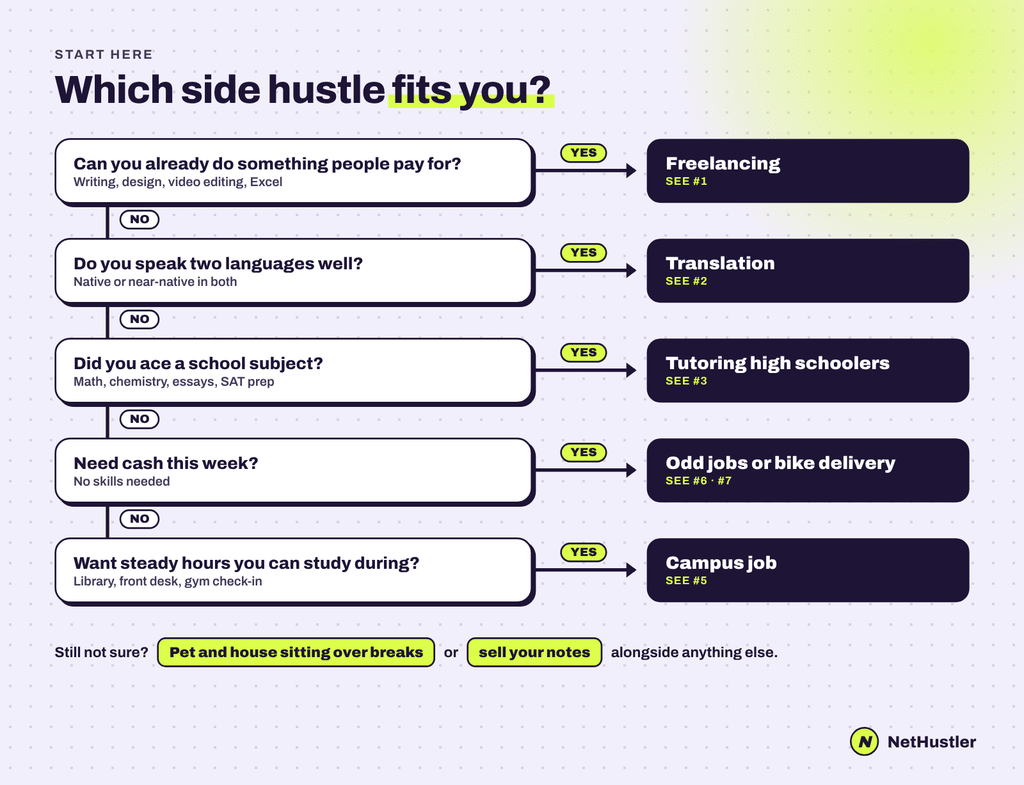
The 8 Side Hustles at a Glance
| # | Side hustle | Realistic pay | Startup cost | The catch |
|---|---|---|---|---|
| 1 | Freelancing one skill | $10 to $25/hr to start | $0 to $20 | Slow first month with no reviews |
| 2 | Translation | $15 to $30/hr | $0 | Machine translation killed the simplest jobs |
| 3 | Tutoring high schoolers | $20 to $50/hr | $0 | Finding the first few families |
| 4 | Selling your notes | A few dollars per sale | $0 | Takes a semester to build up |
| 5 | Campus job with downtime | Minimum wage and up | $0 | Fixed shifts |
| 6 | Odd jobs and TaskRabbit | $40 to $80/hr in big cities | $0 to $25 | Physical work |
| 7 | Food delivery | ~$12 per active hour, gross | $0 on a bike | Car costs eat your margin |
| 8 | Pet and house sitting | ~$17 per 30-min walk after fees | $0 | You keep 80% on Rover |
1. Freelance one skill online
And that’s how I started. And that’s the one I’d push any student toward. It’s the only hustle where the longer you do it, the more you get paid per hour. I’ve earned over $200K on Upwork and the sooner you start earning reviews the sooner that compounding starts.
Upwork’s own data puts beginners at $10 to $25 an hour. Not exciting. What’s exciting is that the same skill pays $50+ an hour a few years later, right when your classmates are starting entry-level jobs.
If I were starting as a student today:
- Choose one skill you’re 70% good at already. Excel, video editing, writing, basic design, social media. Don’t wait to be an expert, perfect time will never come.
- Do cheap, small jobs until you have 5 good reviews. In the beginning reviews mean more than money.
- Increase your rate after a few jobs. Most people forget this and remain cheap for years.
- Use your class projects as your portfolio until you get client work.
Upwork charges 0% to 15% per contract and you pay a little to send proposals. Fiverr takes a flat 20%, and you need to be 18+ for your own account. My Upwork vs Fiverr breakdown covers which one fits you. Before you set a price, run it through the Upwork fee calculator or Fiverr fee calculator to see what you’ll actually keep.
2. Translate (if you speak two languages well)
Translation was my other side hustle and it is the most underrated hustle for students who grew up bilingual or are serious about language study. You have the ability. You just have to tie it up.
For reference, the BLS puts the median for employed interpreters and translators at $28.93 an hour, and about 28% of people in the field are self-employed. As a beginner freelancer you’ll start lower, but it climbs fast once you specialize.
The truth is that the easiest jobs have been eliminated by machine learning and artificial intelligence translation. On its Q2 2026 earnings call, Writing and translation was the hardest hit category, down more than 24%, said Fiverr. The work remaining is the work machines get wrong:
- Reviewing and correcting machine-translated text, often referred to as post-editing
- Marketing copy, websites, where tone is more important than literal meaning.
- Subtitles for Small Video Projects and YouTube Creators
- Less common language pairs with less competition and better pay
Launch on Upwork or Fiverr and get into your niche. “Spanish translator from English” is crowded. Not “spanish subtitles for fitness youtubers”.
P. S. Given how fast AI is advancing in translation, you don’t have much time to make money from this. So an honest advice, don’t build a business around it.
3. Tutor high school students (not your classmates)
This was the top-voted answer in an r/povertyfinance thread on student side hustles, and the logic is solid. College students can’t pay much. Parents of high schoolers can, especially before the SAT, ACT or AP exams.
The commentor charged $30 to $50 an hour and got most of his clients from a list of tutors that the local high school maintained for parents. Another said test prep pays best, but only if your own scores were good and you can prove it. As a baseline, the BLS puts median tutor pay at $20.84 an hour, and the typical entry-level education is some college, no degree.
If you don’t want to find families yourself, Wyzant lets you set your own rate and keeps 25%.
4. Sell your notes and study guides
If you take good notes anyways, you might as well get paid for them. This is about as close to passive income as you get on this list: you do the work once for your own classes, and it continues to sell to students in those classes.
Platforms like Docsity and Stuvia let you upload notes, summaries and study guides and earn each time someone buys them. On Stuvia, for example, you set your own price (minimum $2.50) and the platform takes a 30% commission. And don’t expect to pay rent. That same review has the average Stuvia seller at about $76 a month.
Best sellers here are clean summaries for big intro courses everyone has to take, exam study guides and nice organized notes for hard subjects. Upload right before midterms and finals when students are desperate to get it.
One rule: sell only notes you wrote yourself. Never upload exams, homework answers, or your professor’s slides. Check your school’s academic integrity policy first. Some universities have restrictions on selling course notes.
5. Get a campus job you can study at
The best detail in an r/sidehustle thread came from the freshman asking the question. They worked at the library, and it was slow enough that they did most of their homework on the clock.
That’s the play. Library desks, front desks in the residence halls, gym check-in, ticket offices. The pay is usually minimum wage or so, but if half the shift is study time, then your actual hourly value doubles. Campus departments also hire for one-off shifts like catering events, game days and intramural refereeing if you want extra hours now and then.
If you filed the FAFSA, ask your financial aid office about Federal Work-Study. It funds part-time jobs like these, and Work-Study pay isn’t counted as income on next year’s aid calculation. Regular job pay is.
6. Odd jobs and TaskRabbit
Moving boxes, assembling IKEA furniture, yard work, minor repairs. No skills required, pays more per hour than most “skilled” gigs.
On TaskRabbit, furniture assembly runs $40 to $70 an hour and moving help $45 to $80 in big cities. You set your rate and keep your tips. Signing up costs a one-time $25, and you need to be 18+ with a US Social Security number.
Or ignore the app. One commentor in the r/povertyfinance thread mentioned her elderly mother in a small college town often pays students for odd jobs, and suggested putting up fliers where older locals hang out. Direct clients means no platform fees. The good ones call you back each month.
7. Food delivery (do the math first)
The most flexible choice is to open the app between classes, and close it when you are finished. It’s also the one where the advertized number is most likely to trick you.
Gridwise, which tracks real driver data, puts DoorDash at about $12.43 per active hour in 2025, and roughly $0.92 per mile. Two things shrink that. Time waiting for orders isn’t “active” and you are responsible for gas and wear. If your car costs you 30 cents a mile to operate, you have lost about a third of every mile’s pay.
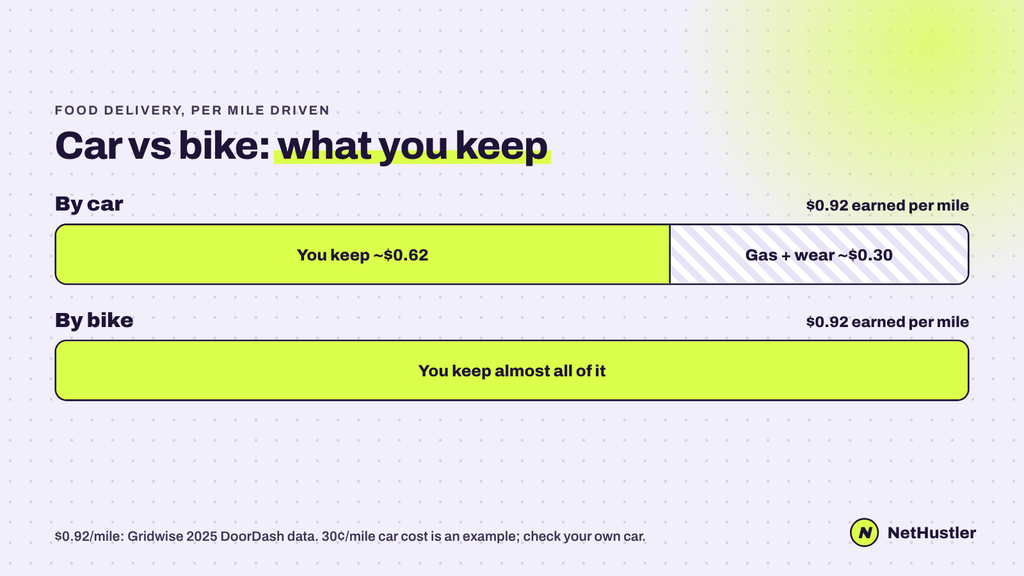
The fix for students is a bike. DoorDash allows bike delivery in select cities with no license or insurance, and Uber Eats allows bike and on-foot delivery from 18. Costs are near zero and the campus is dense with short trips. DoorDash is 18+ in most states, 19+ in some states, and 21+ for new Dashers in California.
8. Pet sitting and house sitting
Consider the people who depart when you do: professors, graduate students, young families near campus. They all need somebody for the dog and the cat and the mail.
On Rover you set your rates and keep 80% in most US states (California fees differ). The national average price for a 30-minute dog walk is about $21, so you keep around $17, and you need to be 18+. Overnight house sits pay more, and if you’re staying in town over a break anyway, a quiet house with a full fridge isn’t a bad deal.
No app beats word of mouth here. Let your department admin know that you are available over breaks.
When Each Hustle Pays Best
The college runs on a calendar and so does demand for most of these. The same hours pay more if you time them right.
| When | What picks up | Why |
|---|---|---|
| Move-in (Aug, Jan) | Odd jobs and TaskRabbit | Everyone needs furniture carried and assembled |
| First weeks of semester | Campus job applications | Departments hire before schedules lock |
| Before midterms and finals | Tutoring, selling notes | Students and parents panic, and pay for it |
| Spring (SAT, ACT, AP season) | High school tutoring at premium rates | Parents pay most right before big exams |
| Thanksgiving, winter and spring break | Pet and house sitting | Professors and neighbors leave town |
| Summer | Freelancing, translation, delivery | Most free time to build reviews and take bigger projects |
Freelancing and translation are year-round activities, so they are perfect anchors for the quiet weeks.
Three Realistic Combos (With Weekly Numbers)
A single hustle rarely fills a student schedule. Usually two or three little ones. These are based on the pay rates above and your local minimum wage and rates will adjust them some.
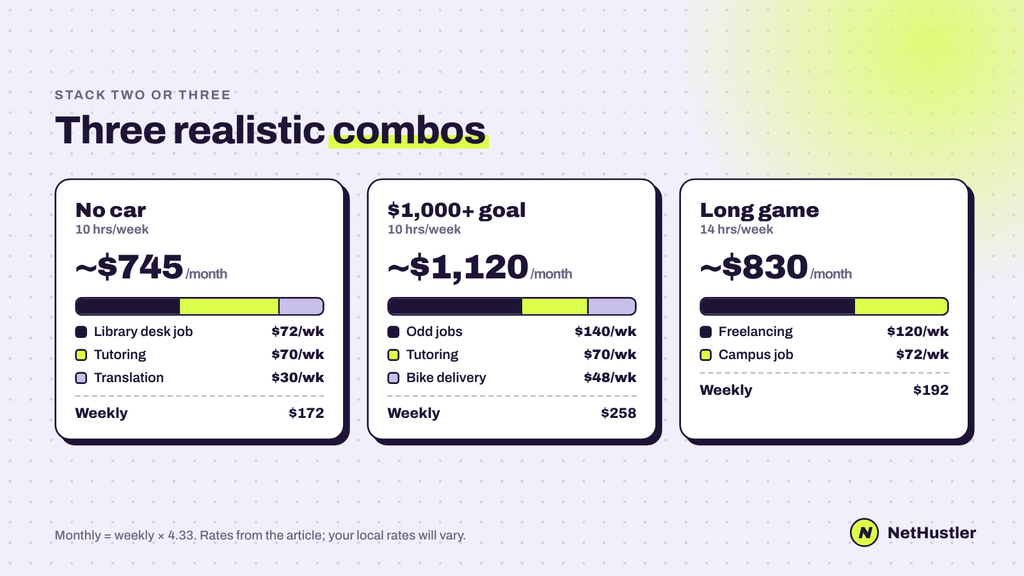
No car, about 10 hours a week (~$745 a month)
| Hustle | Hours | Rate | Weekly |
|---|---|---|---|
| Library desk job | 6 | $12/hr | $72 |
| Tutoring 2 high schoolers | 2 | $35/hr | $70 |
| Translation jobs | 2 | $15/hr to start | $30 |
| Total | 10 | ~$172 |
And whatever your notes that you upload make on the side, and homework that you do in the slow parts of your shift.
Goal of $1,000+ a month, about 10 hours a week (~$1,120 a month)
| Hustle | Hours | Rate | Weekly |
|---|---|---|---|
| Tutoring 2 high schoolers | 2 | $35/hr | $70 |
| Odd jobs for neighbors | 4 | $35/hr | $140 |
| Bike delivery near campus | 4 | ~$12/hr | $48 |
| Total | 10 | ~$258 |
The two highest-paying pieces are direct clients, so no platform takes a cut. Delivery is paid per hour that you are active so time spent waiting between orders will pull that last line down a little.
Building for after graduation, about 14 hours a week (~$830 a month now)
| Hustle | Hours | Rate | Weekly |
|---|---|---|---|
| Freelancing on Upwork | 8 | $15/hr to start | $120 |
| Campus job | 6 | $12/hr | $72 |
| Total | 14 | ~$192 |
This one is slowest to start, but it’s the only combo where your rate increases every semester. By senior year, those same 8 freelance hours are earning $30 an hour, or $240 a week on their own.
Whatever you pick, keep it to about 10 to 15 hours a week during the semester. A Trellis survey found 41% of working students work 40+ hours a week, and research cited in the same article finds grades start to slip once students pass about 20 hours.
What to Skip
Reading those threads was also a crash course in what NOT to do.
One commentor was blunt: half the replies were bots so be careful clicking any site they push. They did not err. Here are a few that were mentioned again and again:
“This app paid for my groceries” comments Dozens of nearly identical comments praising the same survey and gaming reward app, often with a referral link. Real students don’t sound like an ad. Reward apps might pay you a few bucks, but if you see a comment that sounds like marketing, take it as marketing.
Paid “reselling groups” and hidden ways. One reply suggested a $50 a month discord group and opening a 0% credit card to fund inventory. Another was pushing a Telegram scheme with a free guide in PDF. If your main income is selling access to the hustle, that’s their hustle, not yours.
Writing essays on behalf of other students. It came up more than once and it can get you expelled. Not worth it at any price.
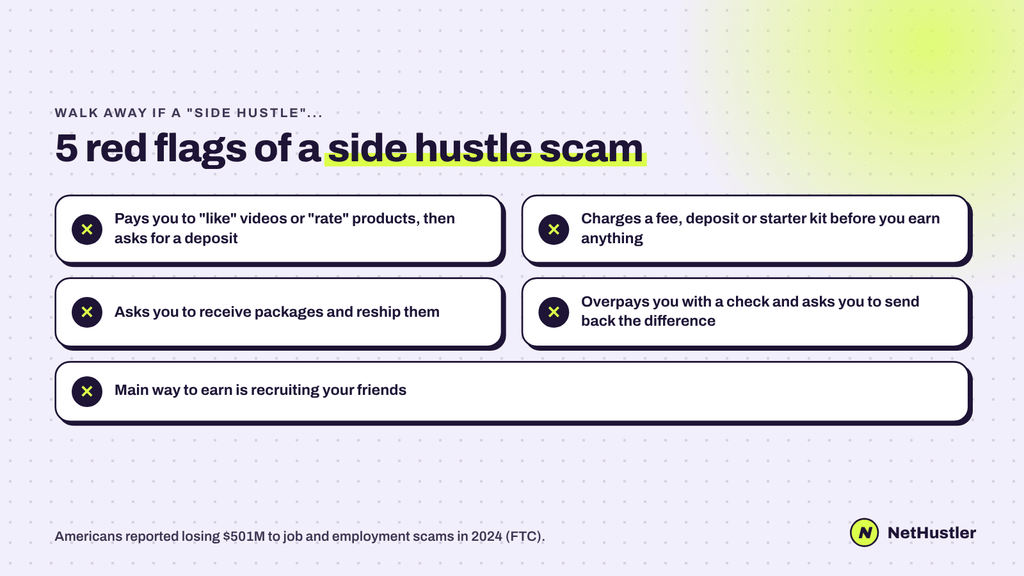
Anything that makes you pay to get paid. “Task” jobs on WhatsApp or Telegram, starter kits, “deposits” to unlock earnings, and checks that overpay you and ask for the difference back. Americans reported losing $501 million to job and employment scams in 2024, up from $90 million in 2020, and task scams went from basically zero in 2020 to about 20,000 reports in the first half of 2024 alone.
Taxes and Financial Aid (Quick, I Promise)
The IRS treats all side hustle income as taxable, including cash and including platforms that never send you a form. If you work for yourself (freelancing, delivery, TaskRabbit, odd jobs), you generally also owe 15.3% self-employment tax once your net earnings for the year reach $400.
The easy habit: move 20% to 25% of every payout into a separate savings account the day it lands. And when you bill clients directly, send a proper invoice. Our free invoice generator makes one in about a minute, and you’ll thank yourself at tax time.
On financial aid: Federal work-study earnings do not count against you on next year’s FAFSA. Other job and self-employment income typically does. Have a chat with your financial aid office about starting to make serious money.
On an F-1 student visa? Off-campus and freelance work rules are strict, even online gigs. Before you do anything, first, speak to your international student office.
FAQ
What is the best side hustle for college students?
Freelancing a skill on Upwork or Fiverr because your rate keeps going up after you graduate. Tutor high schoolers for the best pay now, no setup, often $30 to $50 an hour, more for test prep.
How can I make $1,000 a month as a college student?
10-15 hours a week of mixed hustling will get you there. Two $35 tutoring sessions, four hours of odd jobs at $35, and four hours of bike delivery come out to about $1,100 a month.
How can I make $2,000 a month as a college student?
You will need around 15 hours a week at $30+ an hour or about 25 hours at $19. In reality, that means a few regular tutoring clients, steady freelance clients, or TaskRabbit work in a big city. At 25 hours a week, monitor your grades closely.
What side hustles can I do with no experience?
Odd jobs for neighbors, TaskRabbit, bike delivery, pet sitting and a campus job. No experience needed. If you’re bilingual, translation is a quick start, too, because you already have the skill.
What is the 50/30/20 rule for college students?
It’s a simple budget: 50% of your income goes to needs like rent, food and books, 30% to wants, and 20% to savings or debt. With side hustle income, set aside your tax money first, then split the rest.
Do college students have to pay taxes on side hustle income?
Yes. All side hustle income in the US is taxable, even if it’s cash. If you’re self-employed and have net earnings of $400 or more in a year, you typically also owe 15.3% self-employment tax.
Stay hustlin’
